The reliability score is a single number, from 0 to 10, that every account on Onflow Ads carries. It goes up when a channel owner or an advertiser keeps a deal to the end, and it goes down when they break one. Anyone thinking of dealing with them can see the result before a post is booked or a swap is agreed.
It exists because of an old problem. As the Onflow Ads About page puts it, most channel advertising is still arranged in direct messages between people who have never met, and a subscriber count says nothing about whether either of them keeps a promise. This article explains what the reliability score measures, how it moves, the safeguards that keep it fair, and how to use it.
What is the reliability score?
The Onflow Ads About page states it in one paragraph. Every account carries one reliability score from 0 to 10, read by every part of the platform, and everyone starts at 8.0. Deleting a partner's post early, or accepting a booking and never posting, moves it down.
Three details in that paragraph matter.
- Every account. Channel owners have one, and so do advertisers. Both sides of a deal are measured, not only the seller.
- One score. The guide puts it plainly: there is exactly one score per account. Buying promotions, selling them, swapping posts with another channel, hosting ads in the exchange, hosting Pulse polls and licensing posts with Syndicate all move the same number.
- Everyone starts at 8.0. A new member is trusted from the first day, with room to climb and room to slip.
The policy in the guide explains why it was built. Two strangers agree a deal, one pays first and the other delivers afterwards. Nothing about that is safe unless conduct has consequences that carry forward. The score is that memory: it makes a good record worth something and a bad one expensive, without anyone having to read reviews, ask around or take a risk on a promise.
Why a subscriber count is not enough
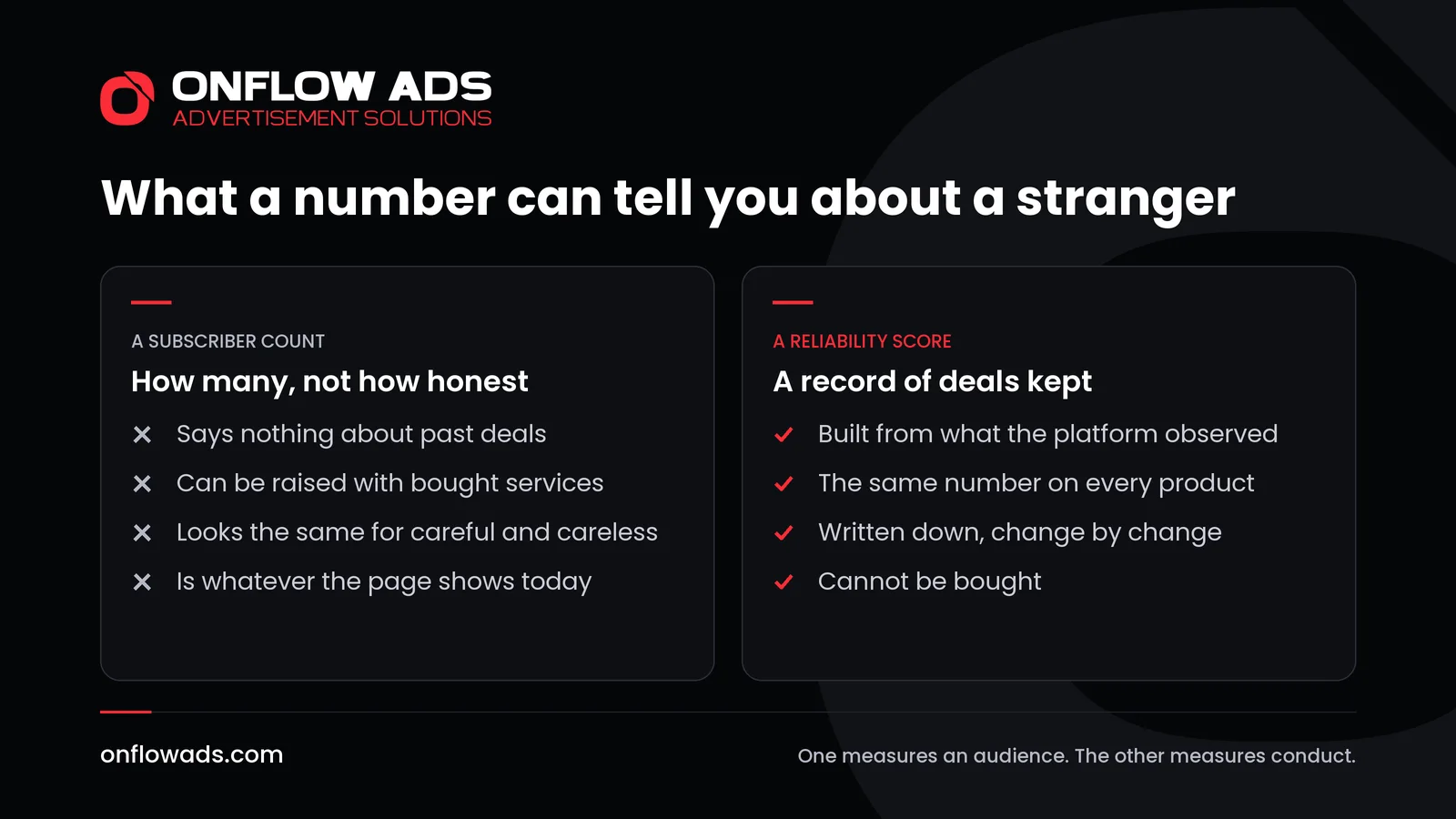
When you choose a channel to advertise in, or a partner to swap posts with, the first thing you see is a subscriber count. It answers one question: how many. It does not answer the question that decides whether you get what you paid for: will this person do what they agreed?
A count has a second weakness. It can be raised without gaining a single reader. Services that sell followers exist, and Telegram's own advertising rules list services for inflating followers among the things that may not be advertised on its platform.
| What it tells you | Who writes it | Can it be bought? | |
|---|---|---|---|
| A subscriber count | How many people follow the channel | The channel | Followers are sold as a service |
| A screenshot or a review | What one person says happened | Whoever sends it | It is easy to produce |
| A reliability score | Whether past deals were kept | The platform, from what it observed | No |
How the reliability score moves
Nothing moves the score by opinion. Each change comes from something the platform itself saw happen, and each has a fixed size that is published in the guide.
| It rises when | It falls when |
|---|---|
| A channel owner delivers a booked post cleanly | An owner lets a request sit unanswered until it lapses |
| An advertiser's campaign runs clean and completes | An accepted booking never runs because the bot lost its place in the channel |
| A channel hosts an exchange ad for its full term | A post is removed before its promised time is up |
| A member's own exchange ad runs clean to the end | A channel posts over an ad that was sold time at the top |
| A penalty is overturned on appeal | A fraud concern is investigated and upheld |
Some marks fall on the buyer's side. An advertiser whose dispute is not upheld loses points for it, and so does one whose payment is reversed fraudulently. The guide adds a line worth remembering: a genuine concern is always safe.
Two things do not move it. Cancelling a booking before it goes live is refunded in full with no effect on anyone's reliability. And a deal with yourself earns nothing: buying your own listing brings no credit to either side.
The safeguards that keep it fair
A score that punished people by mistake would be worse than no score. These rules are what make the number worth trusting.
- Proof first. An automatic penalty needs a fixed record of evidence. A post counts as deleted only if it was gone on several checks spread over time while the bot was still an administrator.
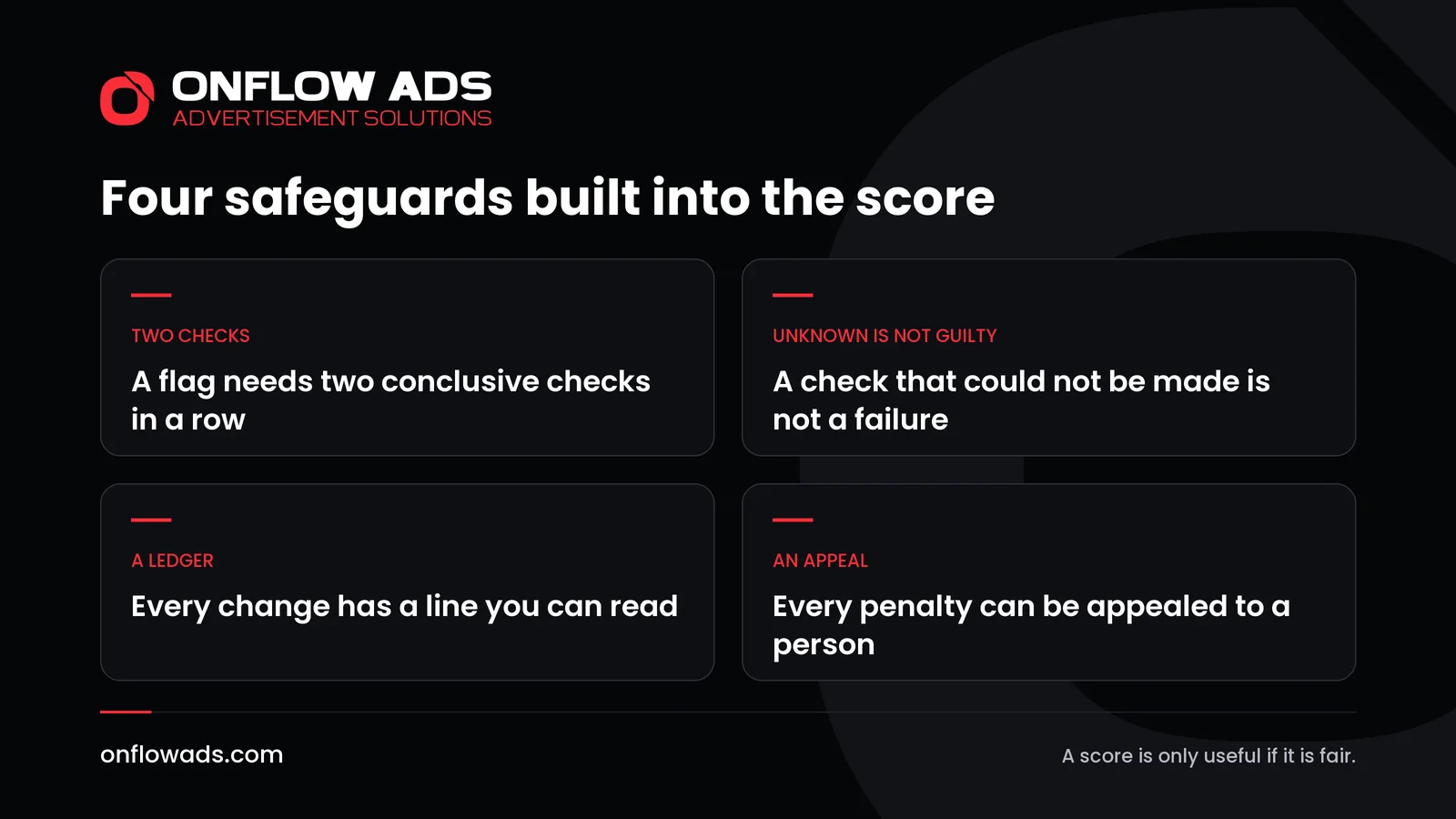
- Two checks, not one. A delivery flag needs two conclusive checks in a row before it stands. One bad reading is not enough.
- Unknown is not guilty. A check that could not tell is recorded as unknown, neither clean nor a breach.
- Confirmed outcomes only. Penalties follow a real non-delivery, an upheld dispute or a post caught removed early. A concern raised against you takes nothing by itself, and a case that needs judgment gives you 48 hours to answer first.
- The platform's failures are not yours. If an ad could not be posted because Telegram was down or an Onflow Ads system failed, there is no automatic penalty. A person reviews the case, and any doubt goes your way.
- Time to fix. A slip that can be put right, such as a removed source line, gets a "Please fix this" notice with a deadline. Fixed in time, it stays a warning.
- A ledger you can read. Every change is listed on your reliability page with its reason. Nothing moves the score without a line you can see.
- An appeal to a person. You can appeal a penalty within 30 days, and a person reads every appeal. A penalty found wrong is undone, with the points it took.
- A dispute holds one booking, not your record. A concern about a booking holds that booking's payout and nothing else. It never freezes your score or changes your band.
It cannot be bought
The guide says this in two short sentences. Nothing you can buy raises it. Plans change your limits and your tools; only conduct changes your score.
That is the point of the whole design. A member cannot pay to look more trustworthy than their record. A score that has dropped drifts back up on its own while the member stays clean, but only as far as the neutral starting point. Anything above it has to be earned with real completed deals.
What the reliability score decides
- Paid Promotions, Cross-Promotion and the Subscriber Exchange each ask for a minimum score before a member can start something new: 4.0, 5.0 and 4.0 today. Below it, that part locks until the score recovers.
- Cross-promotion asks for more than the others. The guide gives the reason: no money sits in escrow in a swap, so trust carries the whole deal.
- Pulse, Brand Lift and Syndicate read the score as a band: Good from 5.0, Watch from 4.0, Restricted below 4.0, and Frozen while an account is under review. The band sets how much a member can host or license at once, and the page always says what is limited and the way back.
- The band also sets when a channel owner is paid: 7 days after a run ends in Good, 10 in Watch, 14 in Restricted and 21 in Frozen. No plan pays faster.
- A higher score lifts a channel's listing up the marketplace, and a low one reduces how far a member's ads reach.
- It works alongside escrow, not in place of it. Escrow protects the money in one deal. The score records how a member behaved across all of them.
Where you see it before a deal
On the pages of the marketplace, a channel can carry a standing grade beside its name: a letter that summarises the owner's reliability score, where the listing publishes it. In the cross-promotion directory, a partner's card shows a related figure: a track record, with the swaps they completed, the swaps they dropped and a reliability percentage.
Use it the way you would use a reference. Read it together with the channel's views and its subject, as how to choose Telegram channels for advertising describes. A large audience with a poor record is a risk. A smaller one with a clean record is a deal that will probably happen as agreed.
How to keep a high reliability score
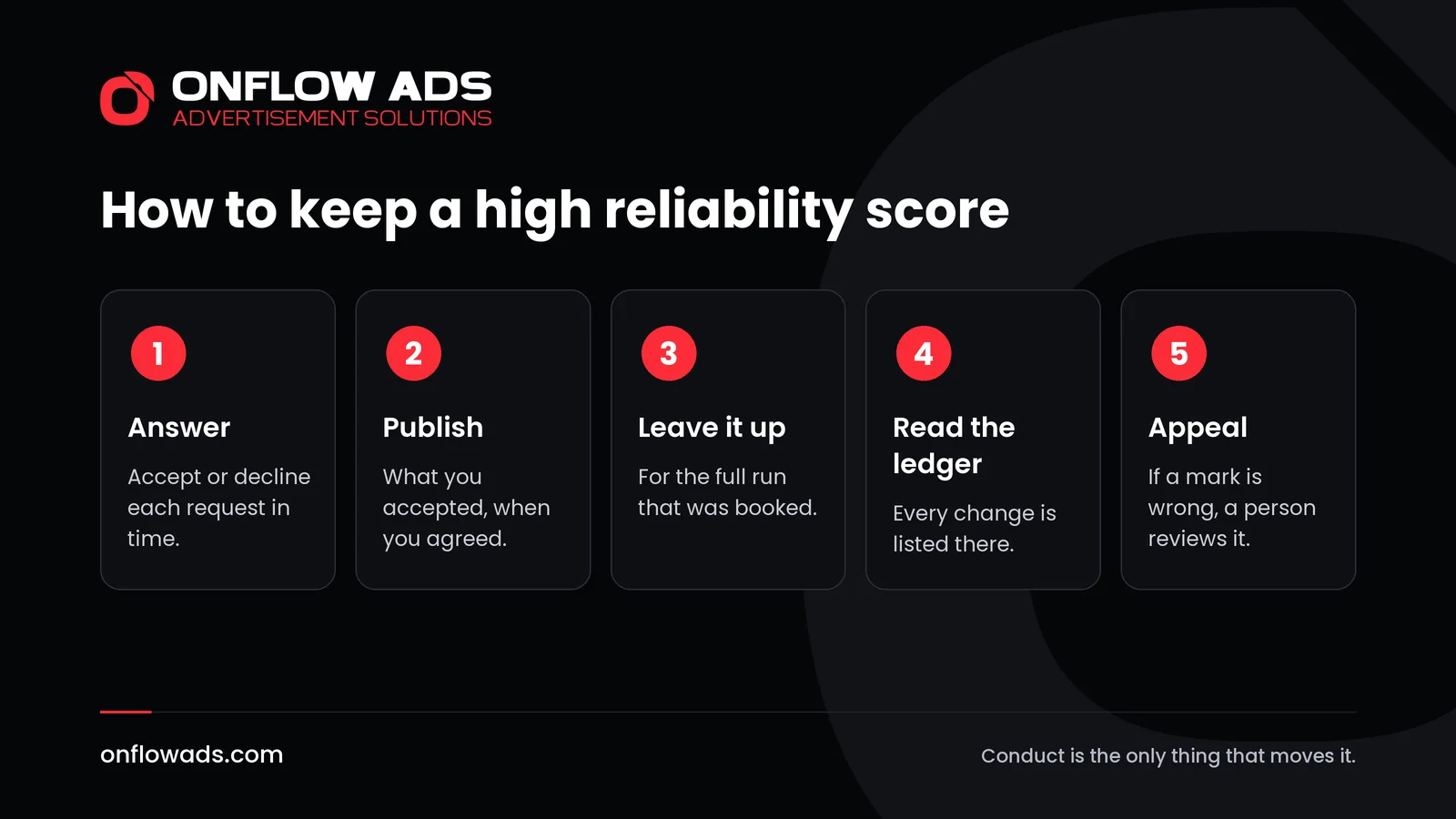
Answer every request
Accept it or decline it. A decline is not on the list of penalties. Letting a request lapse unanswered is.
Publish what you accepted, when you agreed
On Onflow Ads the bot publishes booked posts for you, so the simplest way to deliver is to leave it in place as an administrator of the channel.
Leave the post up for the full run
Removing an agreed post early is treated the same on every part of the platform, whether it was paid for, swapped or hosted.
Read your ledger
Your reliability page lists every change with its reason.
Appeal a mark that is wrong
Press Appeal on the entry within 30 days and say why. A person reviews it.
Buying and running ads is one part of a bigger job. Telegram marketing: the complete guide puts every step in order, from setting up a channel to measuring what each ad brought.
Frequently asked questions
What is a reliability score?
On Onflow Ads it is one number from 0 to 10 that every account carries. It rises when the member keeps a deal and falls when they break one.
What score does a new account start with?
Everyone starts at 8.0, which the guide calls neutral: trusted from day one, with room to climb and room to slip.
Can I pay to raise my reliability score?
No. The guide says nothing you can buy raises it. Plans change limits and tools, and only conduct changes the score.
Do advertisers have a reliability score too?
Yes. There is one score per account, whichever side of a deal the member is on. An advertiser's clean campaigns raise it, and a dispute that is not upheld lowers it.
What lowers the score the most?
The guide calls an upheld fraud concern the heaviest single mark. Removing an agreed post early and an accepted booking that never runs because of the channel also cost points.
Can a penalty be removed?
Yes, by appeal within 30 days. Every appeal is read by a person, and a penalty found wrong is undone with the points it took.
Does a dispute freeze my score?
No. A dispute about a booking holds that booking's payout while a person decides it. It never freezes your score or changes your band.

Comments
Nobody has commented yet.