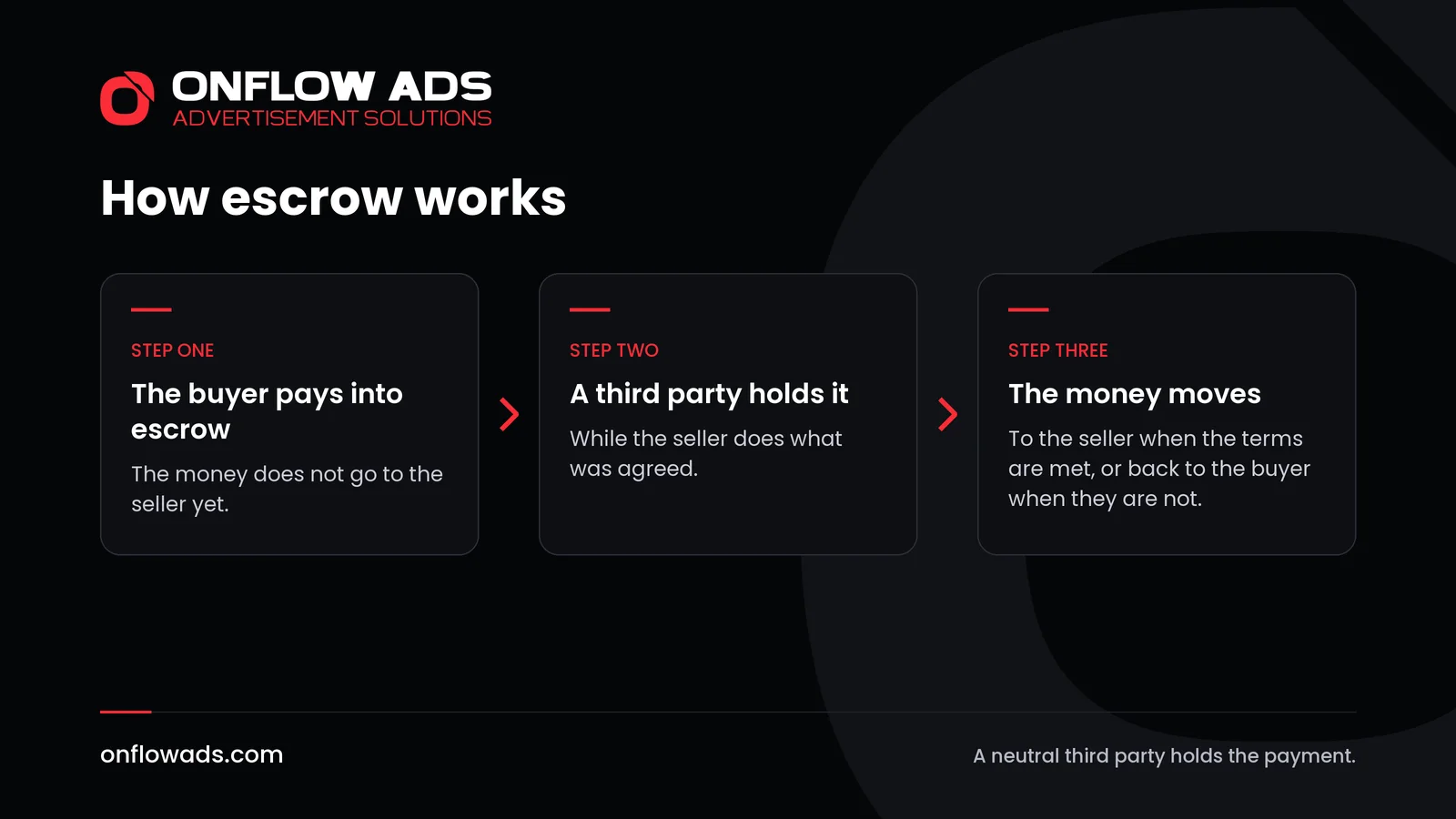
Escrow on Telegram means that a third party holds the payment for a deal until both sides have done what they agreed. When you buy an ad in a channel, the money waits with that third party while the post runs, and it reaches the channel owner only once the post has been delivered. If the post never appears, the money comes back to you.
That matters because a channel ad is often bought in a chat with someone you have never met, in which one of you has to trust the other first. This article explains how escrow closes that gap, the forms it takes on Telegram, how to recognise a fake one, and how to buy a channel ad safely, step by step.
What is escrow on Telegram?
Escrow is an old idea from outside Telegram. Investopedia defines it as an arrangement in which a neutral third party holds funds or assets for two other parties until the conditions of their transaction are met. The buyer knows the seller cannot take the money and disappear. The seller knows the money is already there.
On Telegram, you will meet the word in three places.
- Inside Telegram itself. When someone offers a channel payment for publishing a post, through Telegram's suggested posts, Telegram holds the payment.
- On a marketplace. A platform where ads in channels are booked, such as Onflow Ads, takes the advertiser's payment at checkout and releases it to the channel owner after delivery.
- In a chat. A person, a bot or a group offers to act as the middleman for a deal between two strangers. Whether it can be trusted depends entirely on who runs it, and that is usually the one thing you cannot find out.
Why paying a channel owner directly is risky
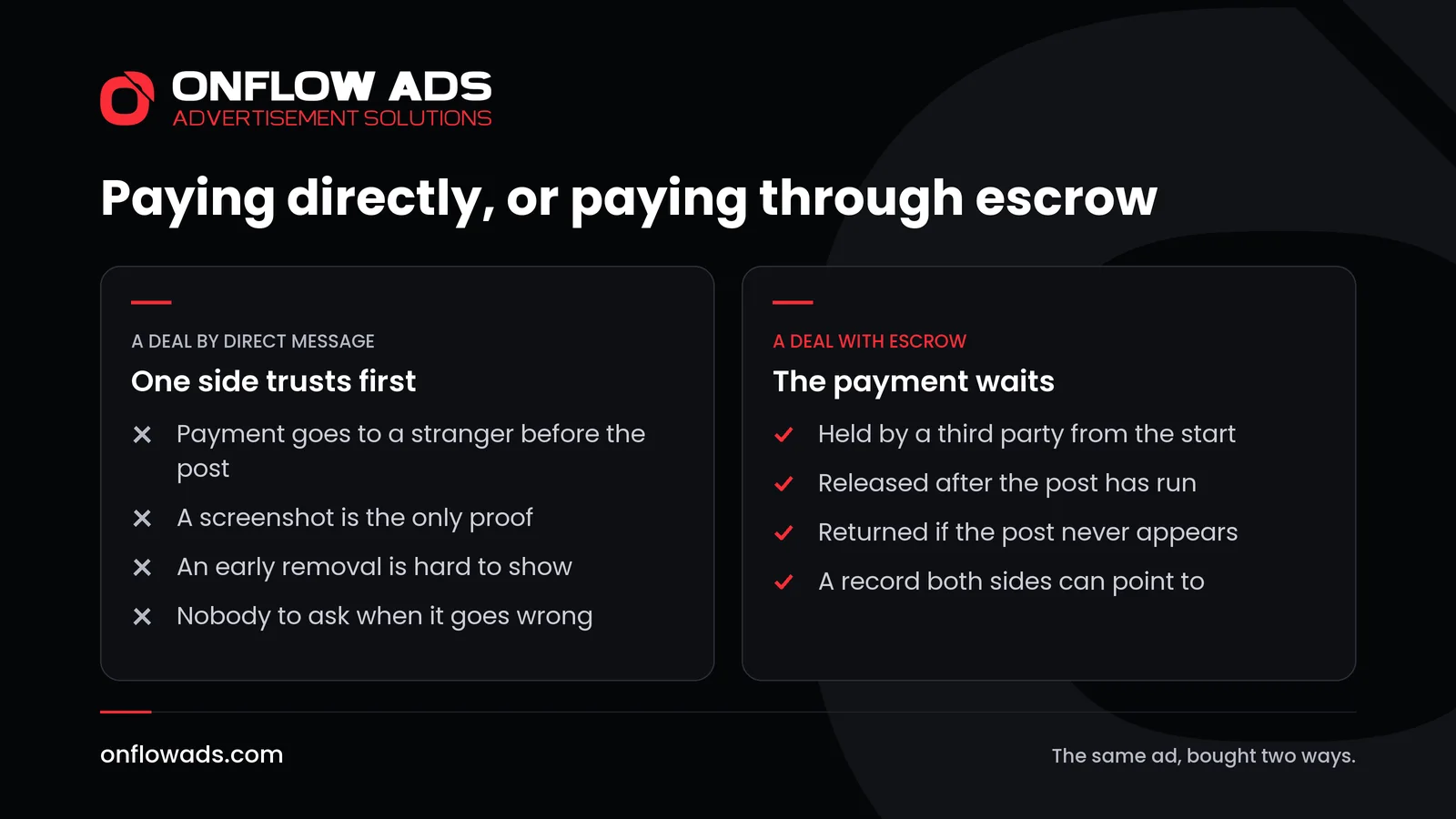
The Onflow Ads About page puts the problem in three sentences: most channel advertising is still arranged in direct messages between people who have never met. One side pays first and hopes. The other posts and hopes to be paid. In a deal like that:
- Payment goes to a stranger before anything is published.
- A screenshot is the only evidence that the ad ran.
- A post can be deleted early, and nobody can show that it happened.
- The audience numbers are whatever the seller says they are.
- When it goes wrong, there is nobody to ask.
None of this means channel owners are dishonest. It means the deal protects neither side, and the owner is exposed too: an owner who publishes first can be left unpaid. Telegram's terms of service forbid using it to scam people, but a rule is not a refund.
How escrow protects both sides
| Stage | A deal by direct message | A deal with escrow |
|---|---|---|
| Payment | Sent to the owner before the post, or promised after it | Held by a third party from the start |
| Proof that the ad ran | A screenshot | Whatever the third party checks before it pays out |
| If the post never appears | You ask for the money back and hope | The money returns to the buyer |
| If the post is removed early | Hard to show afterwards | The payment can be held while it is settled |
| For the channel owner | Publishes first and hopes to be paid | Knows the money is already set aside |
Escrow built into Telegram: paid suggested posts
Telegram added its own protected way to pay a channel for a post in July 2025. With suggested posts, a reader can send a post to a channel through the channel's direct messages and offer Telegram Stars or Toncoin to the owner for publishing it. If the owner accepts, the post is published or scheduled.
Telegram holds the payment. According to its announcement, the channel owner receives the reward 24 hours after posting, and if the post is removed earlier, Telegram returns the full amount to the person who paid. Telegram describes the feature as a safe way to organise promotions with channels.
It is worth knowing what the announcement does not cover. It says nothing about checking a channel's audience before you pay. It also warns owners that a payment made in Stars can later be refunded to the buyer by the app store that sold the Stars, and calls payment in Toncoin the safer choice for them.
How escrow works on Onflow Ads
In the Onflow Ads Paid Promotions marketplace, every booking is backed by escrow, and Onflow Ads is the third party that holds the money.
- You pay at checkout. The money leaves your wallet and moves into escrow, where the channel owner cannot touch it.
- The owner accepts or declines. A decline, or no answer in time, is an automatic full refund.
- The bot publishes the post you booked at the time you booked. The owner does not post it by hand.
- While the post is live, the bot keeps checking that it is still there.
- The owner is paid automatically 7 days after the run ends, once your 72 hours to open a dispute have passed. A delivery flag or an open dispute holds that booking's payment until it is settled.
Three more protections sit around those steps.
- A booking that the owner accepted and never posted refunds itself. You are refunded in full whenever your ad does not run.
- If something went wrong with a post that was published, you can open a dispute until 72 hours after the run ends. It holds that booking's payout while the Onflow Ads team reviews the platform's own record of the placement, not two competing stories.
- On Elite and above, Verified Delivery Insurance refunds a delivery failure that the monitor confirms in full, with no dispute needed.
- Each link in your ad is published as a tracked short link, so every tap is counted, and the record of delivery is kept as proof.
Two things to know before you rely on it. Refunds return to your Onflow Ads wallet as balance to spend on the platform, not to your card or bank. And a dispute that is not upheld counts against the advertiser who raised it, so raise one when you have a real complaint.
The payout date is the same on every plan: 7 days after the run ends, or 10, 14 or 21 days when the owner's reliability is lower. The marketplace's fees are on the pricing page. The guide explains escrow and protection in full, and the Refund Policy sets out every case.
How to buy Telegram channel ads safely
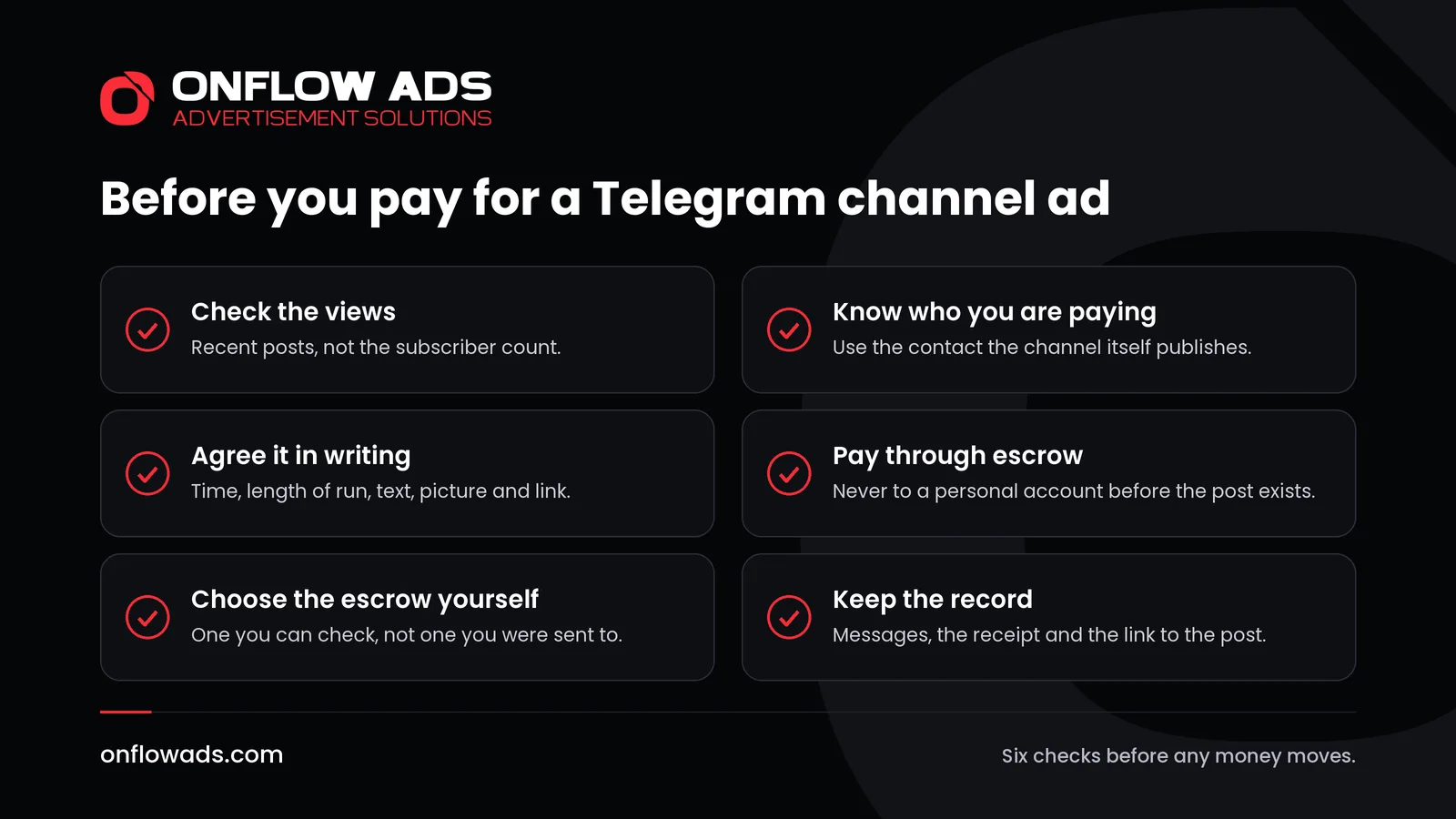
Whichever route you choose, the same seven steps lower the risk.
Decide what the ad is for
Subscribers for a channel, visits to a site or sales of a product. The answer decides which channels fit and what you will count.
Check the views, not the subscriber count
Open the channel and read the counter under its recent posts. Views are what you are buying.
Confirm who you are dealing with
Use the contact the channel itself publishes, or message the channel directly. Someone who claims to sell ads for a channel should be able to show it from the channel.
Agree the terms in writing
The date and time, how long the post stays up, how long it stays the newest post, and the exact text, picture and link.
Pay through escrow
Use Telegram's suggested posts or a marketplace that holds the payment. Do not send money to a personal account before the post exists.
Give the ad its own link
A separate invite link for a channel, or a tracked link for a site, tells you what the ad brought.
Check that it ran, and keep the record
Look at the post when it goes up and again before it comes down, and keep the messages, the receipt and the link.
Step two takes a minute: Telegram shows a view counter on every post in a channel. For step six, Telegram lets owners and admins create additional invite links and shows who joined through each one.
How to recognise a fake escrow
Escrow protects you only when the third party is real and independent. The bogus escrow scam turns the idea inside out: the scammer proposes an escrow service that the scammer secretly runs, so paying into escrow means paying the scammer. Watch for these signs.
- The other side chooses the escrow and will accept no other.
- You cannot find the escrow anywhere except through the link you were sent.
- The payment goes to a personal account or a wallet address, to be held.
- You are hurried: the slot is going, the price ends today.
- The account only resembles an official one, with a letter changed or a different ending.
- Someone asks for a password, a one-time code or card details in a chat.
If something goes wrong
- Stop paying. Do not send a second payment in order to release the first.
- Report the account in Telegram. Every Telegram app has a Report button, and if someone is pretending to be you, Telegram's FAQ tells you which of its accounts to contact.
- Tell your bank or payment provider at once.
- On Onflow Ads, open a dispute from the booking's Details page in Campaigns before your 72 hours run out, or ask Onflow AI in the support chat to file it with you.
- Keep everything: messages, usernames, receipts and links.
If you have a channel but no budget, you do not need to buy ads at all to begin with. Our guide to Telegram cross-promotion and the list of ways to promote a Telegram channel for free cover growing without paying, and this introduction explains how the parts of Onflow Ads fit together.
Buying and running ads is one part of a bigger job. Telegram marketing: the complete guide puts every step in order, from setting up a channel to measuring what each ad brought.
Frequently asked questions
What is escrow on Telegram?
It is an arrangement in which a third party holds the payment for a deal made on Telegram, such as an ad in a channel, and releases it only when both sides have done what they agreed.
Does Telegram have its own escrow?
For one case, yes. With paid suggested posts, Telegram holds the Stars or Toncoin and pays the channel owner 24 hours after the post is published, returning the full amount if the post is removed earlier. A deal made in an ordinary chat is not covered by it.
Are escrow bots and groups on Telegram safe?
Only as safe as the people behind them, and that is usually what you cannot check. Never use an escrow that the other side picked and that you cannot verify for yourself.
Who holds the money on Onflow Ads?
The platform does. At checkout the payment leaves the advertiser's wallet and moves into escrow, where the channel owner cannot touch it.
What happens if the channel owner never posts my ad?
On Onflow Ads the booking refunds itself in full, to your wallet. The same happens if the owner declines or does not answer in time.
Can a channel owner be cheated too?
Yes. An owner who publishes first can be left unpaid. With escrow the money is set aside before the post goes up, and on Onflow Ads the owner is paid automatically 7 days after the run ends, without the advertiser having to do anything.
Comments
Nobody has commented yet.