Telegram cross-promotion is an agreement between two channels to promote each other. Each channel publishes a post that recommends the other, both posts stay up for an agreed time, and neither side pays. You trade reach, not budget, which makes it a natural first step for a channel that has readers but no money for advertising.
This guide walks through the whole of it: how a swap works, where to find partners, how to check a channel before you agree, what to put in the post and how to measure the result. The examples come from Onflow Ads, where swaps are free, but most of the advice holds for any swap you arrange yourself. If you are new here, start with what Onflow Ads is and how it works.
What is Telegram cross-promotion?
A cross-promotion is a simple trade: you show my channel to your readers, and I show yours to mine. You will also see it called a cross-promo, a promo swap, mutual promotion or a shoutout exchange.
It suits Telegram for a practical reason. In a channel only the admins post, and Telegram's guide to channels points out that each post reaches subscribers as a notification on their phones. A recommendation published by a channel therefore lands in front of people who already read about your subject and already trust the channel that is speaking.
A swap is not the same as buying an ad. In a sponsored post, an advertiser pays the channel owner. In Telegram Ads, Telegram's own advertising product, an advertiser pays Telegram for short sponsored messages shown in large public channels. In a cross-promotion the only price is the post you publish in return.
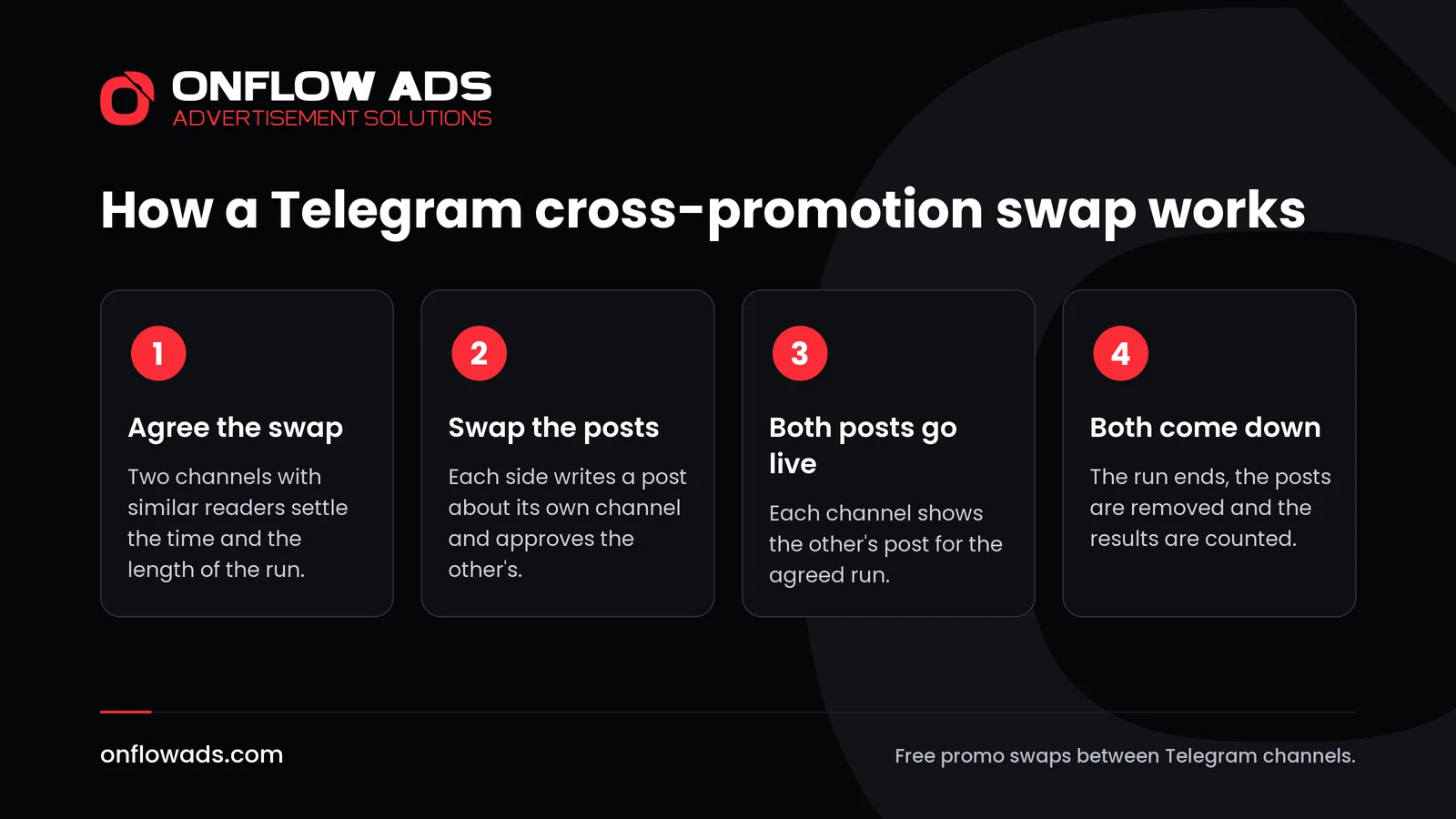
How a cross-promotion swap works, step by step
Find a channel with readers like yours
Look for channels on your subject, in your language and of roughly your size. The closer the two audiences, the more of each will care about the other channel.
Check the channel before you ask
Read its recent posts and compare the view counter under them with the subscriber count. The checks are listed further down this page.
Agree the terms
Settle the date and time, how long both posts stay up, and whether anything else may be posted above them straight away. Put it in writing.
Exchange the posts
Each side writes the post about its own channel and sends it to the other. Read what you are asked to publish before you say yes.
Publish at the agreed time
Both posts go up together, so that neither side goes first and waits.
Keep the post up for the whole run
Taking a partner's post down early is the one real way to cheat in a swap. Leave it alone until the agreed end.
Count the result
Note the views on your post in the partner's channel and how many people joined through the link you gave. Then decide whether to repeat the swap.
Where to find cross-promotion partners
Good partners are usually closer than you think. Five places to look:
- Channels you already read. If you follow a channel on your subject, its readers are the people you are looking for. Start there.
- Telegram's own list of similar channels. A public channel's profile shows similar channels, which Telegram says it selects automatically from similarities in their subscriber bases. The channels listed beside yours have audiences like yours, which is exactly what a swap needs.
- Catalogues of channels. Sites such as TGStat list Telegram channels and groups by country, with ratings and analytics, which helps you find channels of a similar size.
- Groups for channel admins. Swaps are also arranged in Telegram groups where owners post offers. They are quick, but nobody there checks that a post went up or stayed up, so everything rests on the other person's word.
- A partner directory. On Onflow Ads, channels that want swaps list themselves in an opt-in directory, ranked by how well each one matches your own channel.
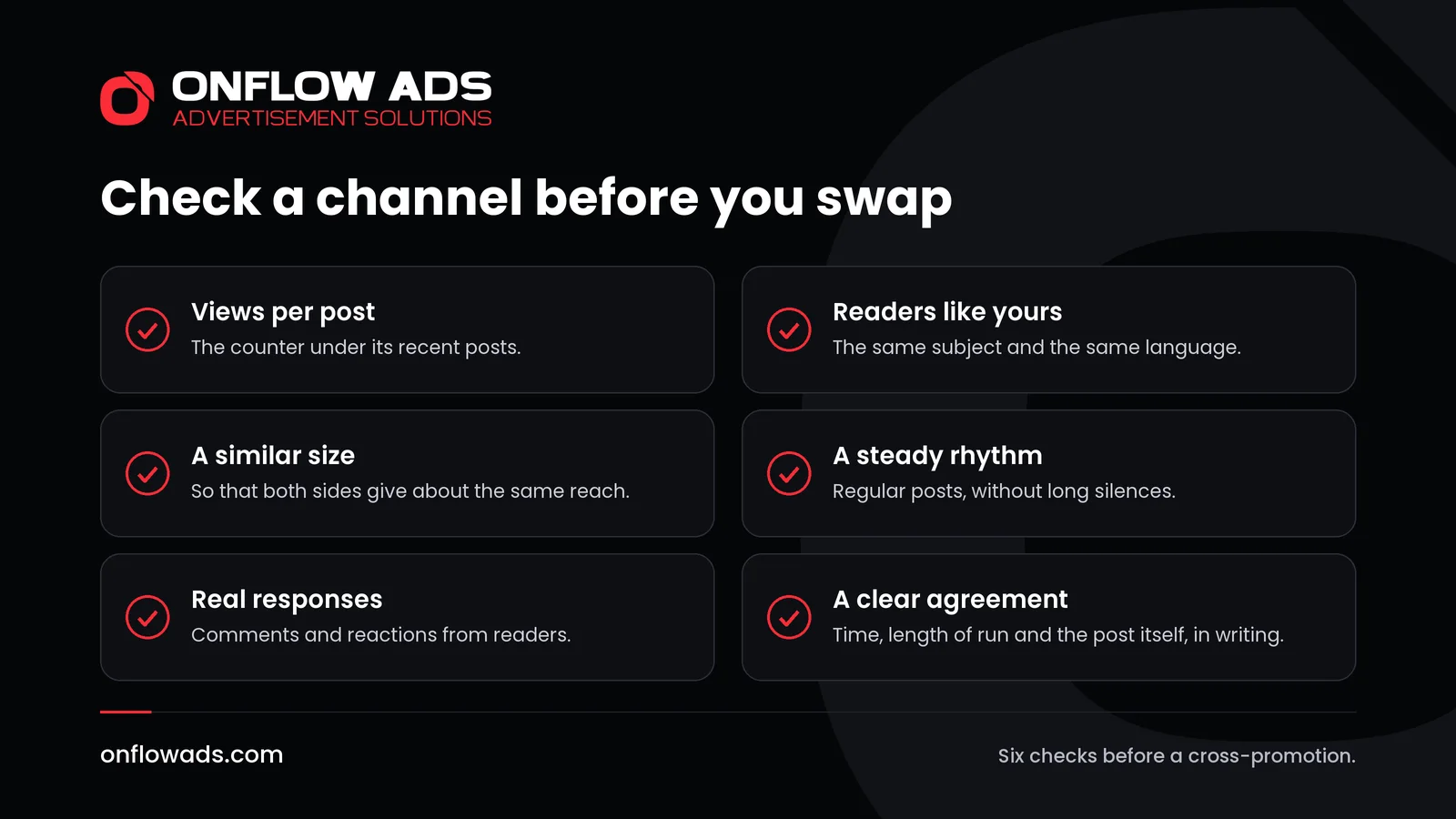
How to check a channel before you swap
A subscriber count tells you how many people once pressed Join. It does not tell you how many still read. Before you agree to a swap, look at these.
| What to check | Where to look | What it tells you |
|---|---|---|
| Views per post | The eye counter under each recent post | How many people your promo post is likely to reach. Telegram shows a view counter on every channel post. |
| Views compared with subscribers | Typical views divided by the subscriber count | How much of the audience still opens the channel |
| Subject and language | The last twenty or so posts | Whether its readers would want your channel |
| How often it posts | The dates on recent posts | How quickly your post will be pushed down the feed by new ones |
| Comments and reactions | Under recent posts, where the channel has them switched on | Whether people respond to what is published |
On Onflow Ads you do not have to take these figures on trust. The bot reads a connected channel's subscriber count from Telegram itself, so a listing carries a measured number, not one the owner typed in. Each partner card shows subscribers, average views and subject, a verdict on how well the two channels match in size, a track record of completed and dropped swaps, and a star rating from earlier partners. The guide explains how the verdict and the track record work.
What to agree before the swap
- The date and time both posts go up, with the time zone.
- How long both posts stay up.
- Whether either channel may post again straight away. Sellers of channel ads often write this as two numbers: in a 1/24 placement the post stays the newest in the channel for one hour and in the feed for 24 hours, as AdsGram's guide to buying Telegram ads describes it.
- The post itself: the words, the picture and the link. Each side should see what will be published in its channel and approve it.
- What happens if one side has to cancel.
How to write a promo post that brings subscribers
Your post runs in someone else's channel, in front of people who have never heard of you. They decide in a few seconds, so make those seconds easy.
- Say what the channel is in the first line. "One chess puzzle a day, with the answer the next morning" tells a reader more than "the best chess channel on Telegram".
- Give one reason to join now: what a new reader will get this week.
- Show a sample. Quote one of your best posts, or sum it up in a sentence.
- Use one link, and make it the last thing they read.
- Write for the partner's readers, in the tone that channel uses.
On Onflow Ads each side writes the post that promotes its own channel: text with formatting and links, and a photo if you want one. The other side sees the post and approves it, or sends it back for changes, before anything runs. The guide describes exactly what gets posted.
How to measure a cross-promotion
The most useful tool is built into Telegram. Beside a channel's main invite link, owners and admins can create additional invite links, and Telegram shows which users joined through each one. Make one link per swap, put it in the promo post, and you will know how many subscribers that partner sent.
| Number | Where it comes from | What it tells you |
|---|---|---|
| Views of your post | The counter under the post in the partner's channel | How many people saw the offer |
| Joins | The invite link you made for this swap | How many accepted it |
| Joins per 100 views | Joins divided by views, times 100 | How well the post and the audience matched |
| Change in your subscribers | Your own channel's statistics | The whole picture, including people who joined for other reasons |
An example with made-up numbers: if the post was seen 2,000 times and 40 people joined through the link, that is 2 joins for every 100 views. Compare swaps with each other by that figure, not by the raw number of joins, because channels differ in size.
Onflow Ads does the counting for you. After a swap you see how many people opened each ad, how many joined each channel through it, each channel's change in subscribers over the run, and links to the delivered posts, so that both sides can check the swap really ran. Two honest limits: the join figure is an indicator, not an audited count, and the change in subscribers includes people who arrived for other reasons. The details are in the guide to campaign results.
Common mistakes in cross-promotion
- Swapping with a channel on another subject because it is big. Its readers did not come for your subject.
- Posting something of your own straight after the partner's post, which pushes it out of sight.
- Taking the partner's post down early. It ends the partnership.
- Running so many swaps that your channel reads like a noticeboard. Your own readers are what you are trading with.
Cross-promotion on Onflow Ads
Onflow Ads makes the swap itself the easy part. Cross-Promotion is free. It needs a free account and a public Telegram channel with the Onflow Ads bot added as an administrator, which is also how you show the channel is yours.
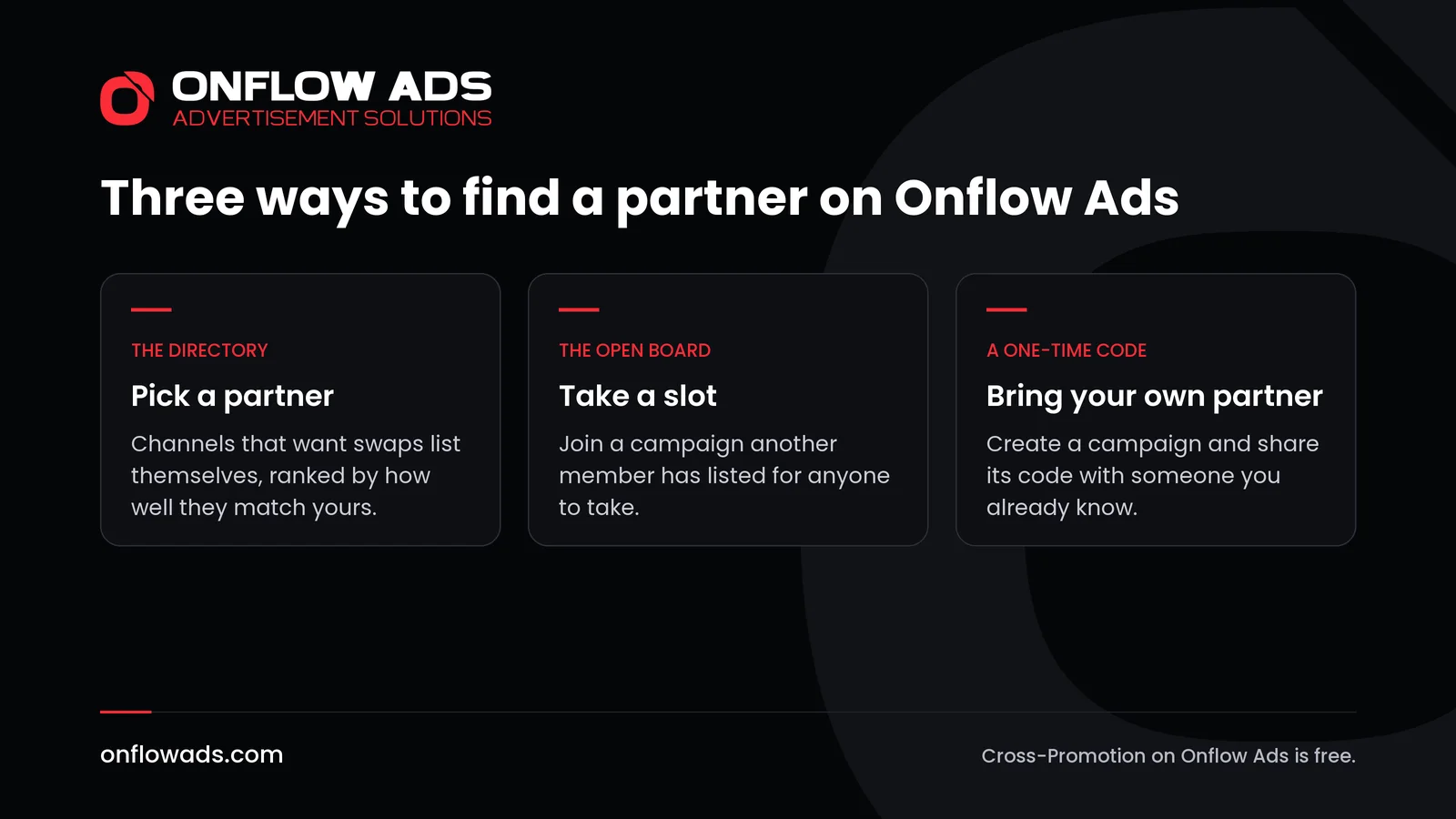
There are three ways to find a partner. Browse the opt-in directory and send a swap request with a proposed schedule. Take a slot on the board of open campaigns. Or create a campaign and share its one-time code with someone you already know. The guide covers finding partners in detail. From there, every swap follows the same six steps:
- Pair up, through the directory, the board or a code.
- Agree the schedule: the date, the time and the length of the run.
- Each side writes the post that promotes its own channel.
- Each side reviews the post that will appear in its channel.
- The bot publishes both posts at the agreed time and removes both when the run ends.
- Both sides see the results and can rate each other.
Two details matter more than they look. If the bot cannot publish both posts, it publishes neither, so nobody goes first and waits. And while the posts are live, the bot checks silently that each one is still there. Removing a partner's post before the agreed end is noticed without anyone having to report it, and it costs the channel that did it its standing.
A partner who worked out can become a regular one: a swap can repeat weekly, fortnightly or monthly, if your partner accepts. How many swaps you can start in a month depends on your plan, joining a swap someone else started is always free, and a few optional extras, such as a featured place in the directory, are paid. A post that links outside Telegram costs a flat $1 on every plan. On Master and Ultimate you can also start a Blitz, one campaign in which several partners go live together, and anyone can claim a slot in one. What each plan includes is on the pricing page.
Cross-promotion, sponsored posts or Telegram Ads?
The three are different tools, and nothing stops a channel from using more than one.
| Cross-promotion | Sponsored post in a channel | Telegram Ads | |
|---|---|---|---|
| What you pay | A post in your own channel | A price set by the channel owner | Telegram, for each thousand views |
| What readers see | A full post in the channel's feed | A full post in the channel's feed | A short sponsored message |
| Where it appears | Your partner's channel | The channel you booked | Public channels that you choose |
If you would rather pay for reach than trade for it, sponsored posts are booked in the Paid Promotions marketplace, and Telegram describes its own product in the Telegram Ad Platform guide.
Swaps are one of the free methods in our complete guide to Telegram marketing, which puts every step in order, from setting up a channel to measuring results.
Frequently asked questions
Is Telegram cross-promotion free?
A swap you arrange yourself costs nothing but the post you publish in return. On Onflow Ads the swap itself, the vetting of partners and the results are free, unless your post links outside Telegram, which costs $1. A few optional extras are paid, and they are listed on the pricing page.
How many subscribers do I need to start cross-promotion?
There is no fixed number. What matters is finding a partner of a similar size, so that the trade is fair to both. Onflow Ads sets no minimum subscriber count for cross-promotion today: the channel has to be public and connected.
Can a private channel take part?
You can arrange a swap for a private channel yourself, with an invite link. On Onflow Ads only public channels, the ones with a username, can be cross-promoted.
How long should the posts stay up?
As long as you both agree. Decide it before the swap and keep to it. On Onflow Ads you choose the length of the run when you set the schedule, and the bot removes both posts at the end.
What if my partner deletes my post early?
In a swap arranged by message, there is little you can do except not work with that channel again. On Onflow Ads the bot checks that both posts stay up for the whole run. An early removal is confirmed by more than one check before it counts, and then it is recorded against the channel that did it. You do not have to report it.
What is the difference between cross-promotion and a subscriber exchange?
In a cross-promotion you choose one partner and the two of you swap posts. In the Onflow Ads Subscriber Exchange you do not pick partners: you host other members' ads in your channel, and your own ad is placed in channels of a similar audience size and subject.
Comments
Nobody has commented yet.