A Telegram subscriber exchange is any arrangement in which channel owners help each other gain subscribers without paying for advertising. The phrase is used for two very different things. In one, owners simply join each other's channels. In the other, channels show each other's ads and readers decide for themselves. The first raises a number. The second puts your channel in front of people who can choose to read it.
This article explains both, shows why only the second is worth your time, and sets out how to keep an exchange honest. It follows our guides to Telegram cross-promotion and to shoutout exchanges, which cover swaps between two channels that know each other.
What is a Telegram subscriber exchange?
The same words cover two arrangements, and they have almost nothing in common.
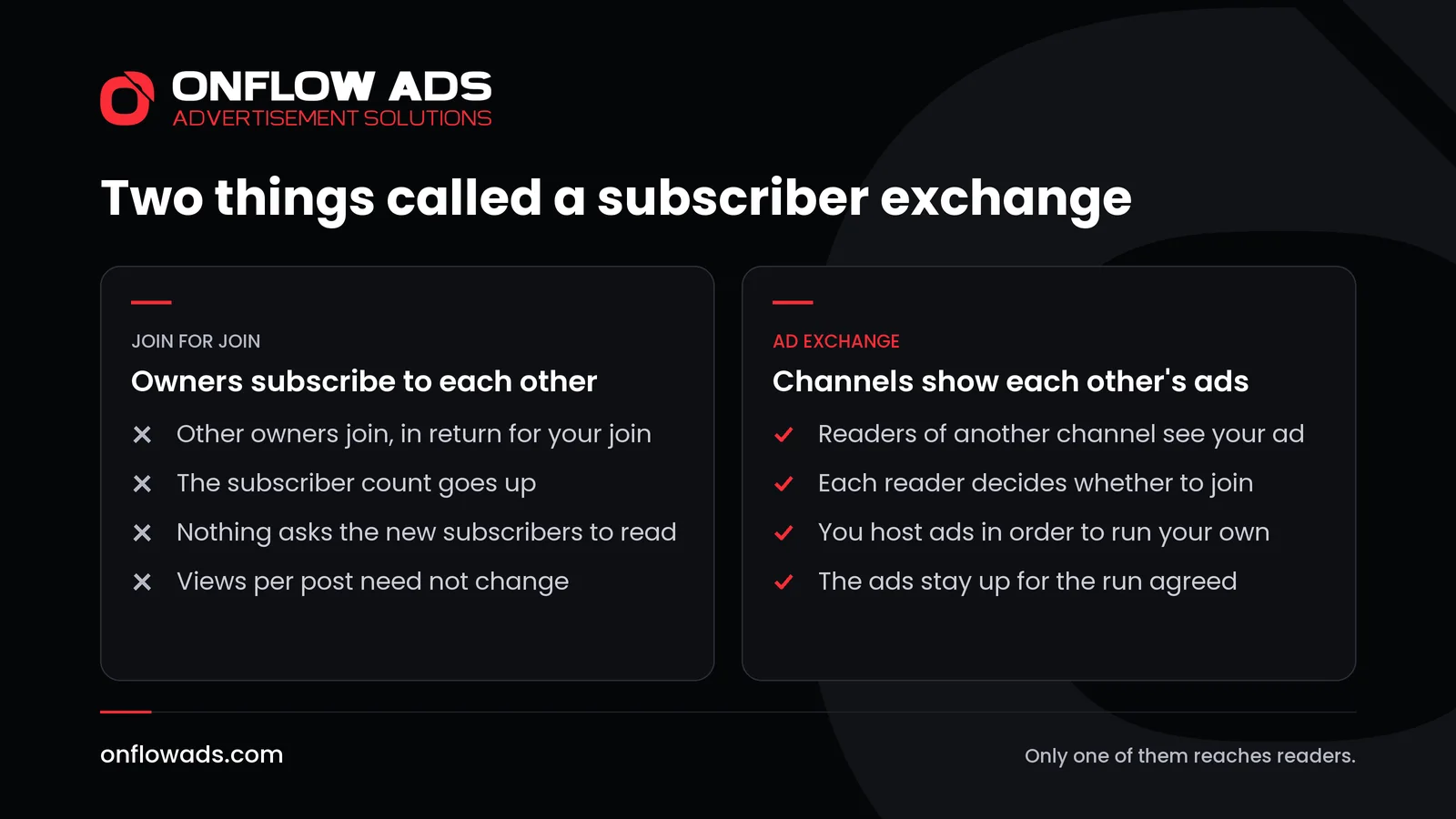
| Join for join | Ad exchange | |
|---|---|---|
| What happens | Owners subscribe to each other's channels | Channels publish each other's ads |
| Who joins your channel | Other owners, in return for your own join | Readers of another channel who liked your ad |
| What you give | A subscription from your own account | A post in your channel for a set time |
| Who decides | The two owners | Each reader, one at a time |
| What grows | The subscriber count | The number of people who see your channel |
Why join for join does not grow a channel
A subscriber who joined because you joined them back did not choose your channel for what it publishes. Nothing in the trade asks them to read it, and they can mute it or leave whenever they like. Unless they start reading, the count goes up and the views per post stay where they were.
That gap is visible to anyone who looks. Every post in a channel carries a view counter, so a partner or an advertiser can set the views beside the subscriber count in a few seconds. A channel with ten thousand subscribers and two hundred views per post reaches fewer people than a channel with one thousand subscribers and four hundred views, and anyone who checks will see it.
You can see it from the inside too. Telegram's channel statistics show how many users join, leave and mute a channel, which tells you quickly what a batch of new subscribers was worth.
YouTube treats the practice as fake engagement: its rules name offers to subscribe to a channel only in return for a subscription among the things it does not allow. Telegram's terms of service are brief and say nothing on the subject, but the arithmetic is the same wherever you publish.
How an honest subscriber exchange works
An honest exchange trades attention, not accounts. It has four marks.
- Readers choose. Your channel is shown to the readers of another channel, and each one decides whether to join.
- Both sides give as well as get. You carry other channels' ads in order to run your own.
- The ad reaches a fitting audience. An ad belongs in channels whose readers might want what it offers.
- Somebody checks. The ads stay up for the time agreed, and the numbers are counted by something other than the two owners' word.
A swap of posts between two channels meets these marks when both owners keep their word. An exchange run by a platform can meet them for many channels at once.
How the Onflow Ads Subscriber Exchange works
The Onflow Ads Subscriber Exchange is a free, reciprocal ad exchange for Telegram channel owners. You agree to host other members' ads in your channel, and in return you can run your own ad across the other members' channels. Hosting and running ads cost nothing: the exchange runs on reciprocity, not money. Only an ad that links outside Telegram costs $1, and a few optional extras, such as faster delivery, are paid.
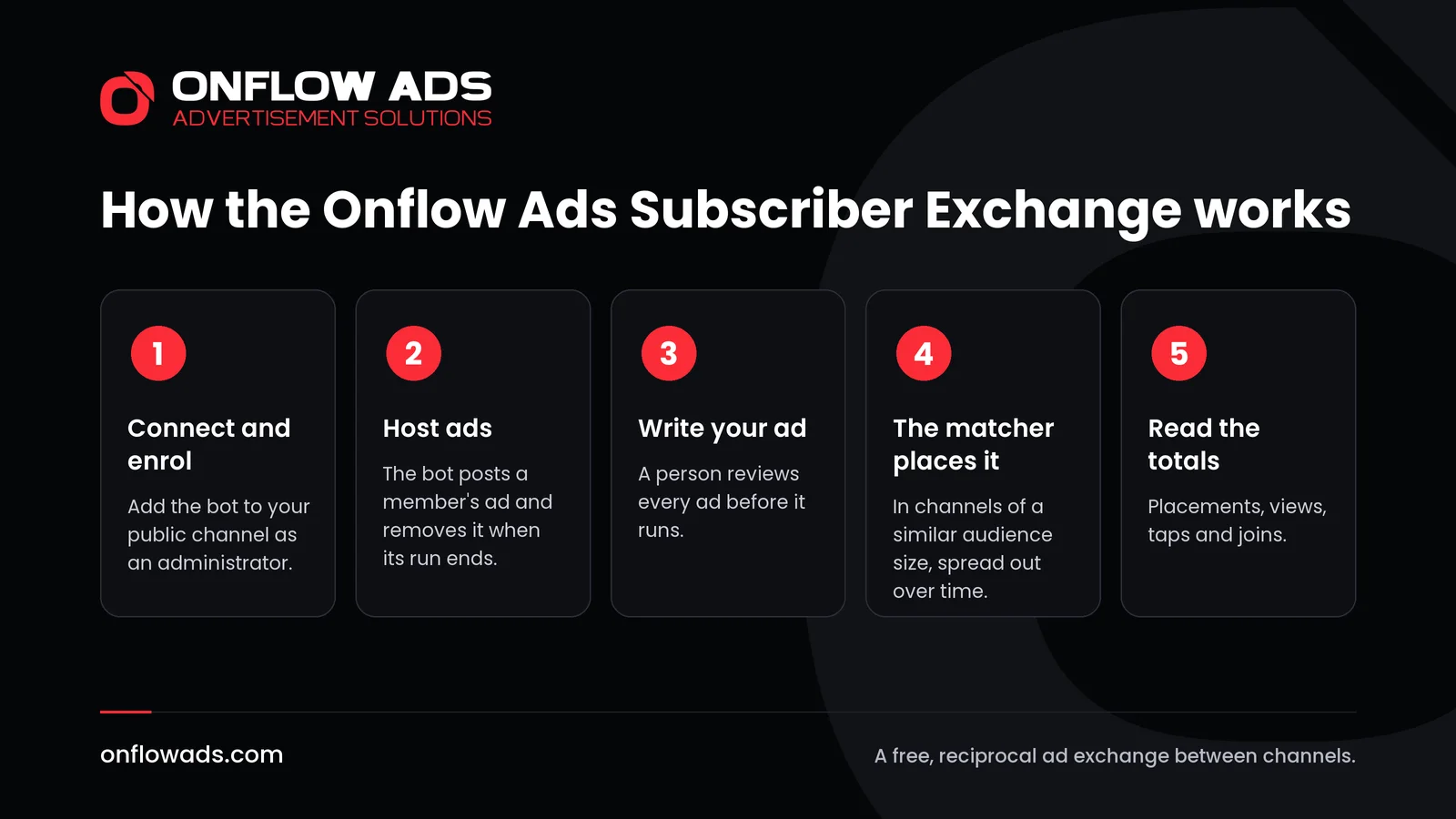
Connect Telegram
Create a free account and connect your Telegram account to it.
Enrol a channel
Add the Onflow Ads bot to your public channel as an administrator, and choose the highest content level you are willing to host.
Host ads
The bot posts a member's ad in your channel, leaves it up for its full run and then removes it. You do nothing.
Write your own ad
Build an ad on the website and submit it. A person reviews every ad before it runs.
Let the matcher place it
Once approved, your ad is placed in other members' channels of a similar audience size, spread out over time, never all at once.
Read the totals
You see how many placements ran and the views, taps and joins they brought.
Hosting comes first: you cannot run an ad until at least one of your channels is enrolled and active. The exchange takes public channels with at least 1,000 subscribers, as the guide's getting started page sets out.
Who decides what appears in your channel
Giving a bot the right to post in your channel is a real decision, so the exchange leaves the last word with the host.
- You set the highest content level your channel accepts. Gambling, betting and adult content are not carried at all.
- You can ask to review every ad before it posts. That is a protection for hosts, open on every plan.
- You can refuse an ad that is already live. It comes down, it never returns to that channel, and it costs you nothing.
- Money does not buy a way round a host. Paid plans and extras buy things such as capacity and a place at the front of the review queue, never a bypass of a host's settings or of a refusal.
- Both sides stay anonymous. Advertisers see totals, never which channels ran their ad, and hosts never learn who wrote an ad they carried.
How to keep a subscriber exchange honest
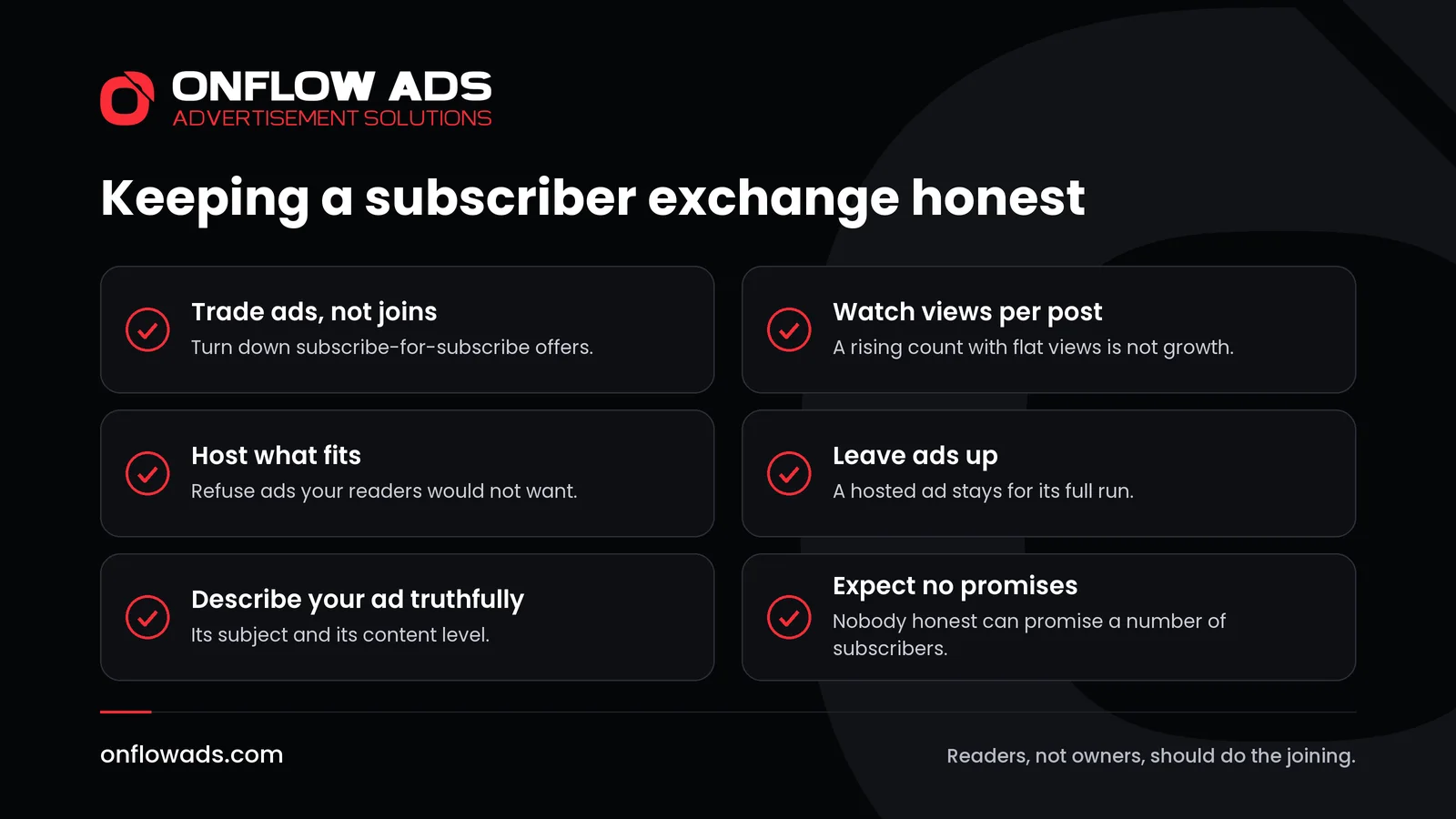
- Trade ads, not joins. Turn down any offer that asks you to subscribe in return for a subscription.
- Watch views per post. If the count rises and the views do not, the new subscribers are not readers.
- Host only what fits your readers, and refuse what does not.
- Leave hosted ads up for their full run. In the Onflow Ads exchange, removing a hosted ad before its time is the rule every other rule follows from: it is detected automatically, and it costs the host its standing.
- Describe your own ad truthfully: its subject and its content level.
- Expect no promised numbers, and distrust anyone who offers them.
The exchange has only a handful of rules, and they are enforced automatically and shown openly. They are set out in the guide under rules and fair play.
What a subscriber exchange will not do
It will not promise you subscribers. What the Onflow Ads exchange promises is about placements: that an ad stays up for its full run, that placements are spread out, that hosts control what they carry and that channels are matched by audience size. Whether readers join depends on your ad and on your channel.
It is not a guaranteed supply of placements either. Placements depend on real channels being available and willing, so an ad may wait until there are enough suitable channels to carry it.
If you need a placement in a particular channel on a particular day, that is a sponsored post, and it is booked in the Paid Promotions marketplace.
Subscriber exchange or cross-promotion?
| Subscriber Exchange | Cross-Promotion | |
|---|---|---|
| Your partner | Chosen for you by the matcher | Chosen by you |
| Who knows whom | Both sides stay anonymous | You know your partner |
| How many channels | Many, over time | One partner in each swap |
| Your part | Host other members' ads | Publish your partner's post |
| What it costs | Nothing | Nothing |
The two work together: a swap with a partner you know, and the exchange for steady exposure beyond the channels you know. Both are part of the same free account.
Swaps are one of the free methods in our complete guide to Telegram marketing, which puts every step in order, from setting up a channel to measuring results.
Frequently asked questions
Is a Telegram subscriber exchange free?
The Onflow Ads Subscriber Exchange is: hosting and running ads cost nothing, and only an ad that links outside Telegram costs $1. A few optional extras are paid, and they are on the pricing page.
Will a subscriber exchange bring me real subscribers?
It depends which kind. Join for join brings you other owners, not readers. An ad exchange shows your channel to the readers of other channels, and the ones who join chose to. No honest exchange promises a number.
Are subscriber exchange groups worth joining?
For meeting other owners, perhaps. For growth, a group in which everyone joins everyone raises counts and not views. If you find a good partner there, propose a swap of posts instead.
Can I choose which ads appear in my channel?
Yes. You set the highest content level you accept, you can review each ad before it posts, and you can refuse an ad that is already live without any penalty.
How is a subscriber exchange different from buying subscribers?
In an exchange nobody is paid, and readers decide whether to join. A service that sells subscribers delivers a number that you ordered, not readers who chose your channel.
Does my channel have to be public?
Yes. The exchange works with public Telegram channels only, and a channel needs at least 1,000 subscribers to be enrolled.
Comments
Nobody has commented yet.