
How much should you charge for Telegram ads on your channel? There is no price list that fits every channel, and anyone who quotes you one figure for a subscriber count is guessing. There is a method, though, and it takes ten minutes: work out how many people see a typical post, decide what a thousand of those views is worth in your subject, and multiply.
This guide walks through that method with worked examples, shows what pushes a price up or down, and explains how to turn the result into a rate card that advertisers can book from.
What an advertiser is paying for
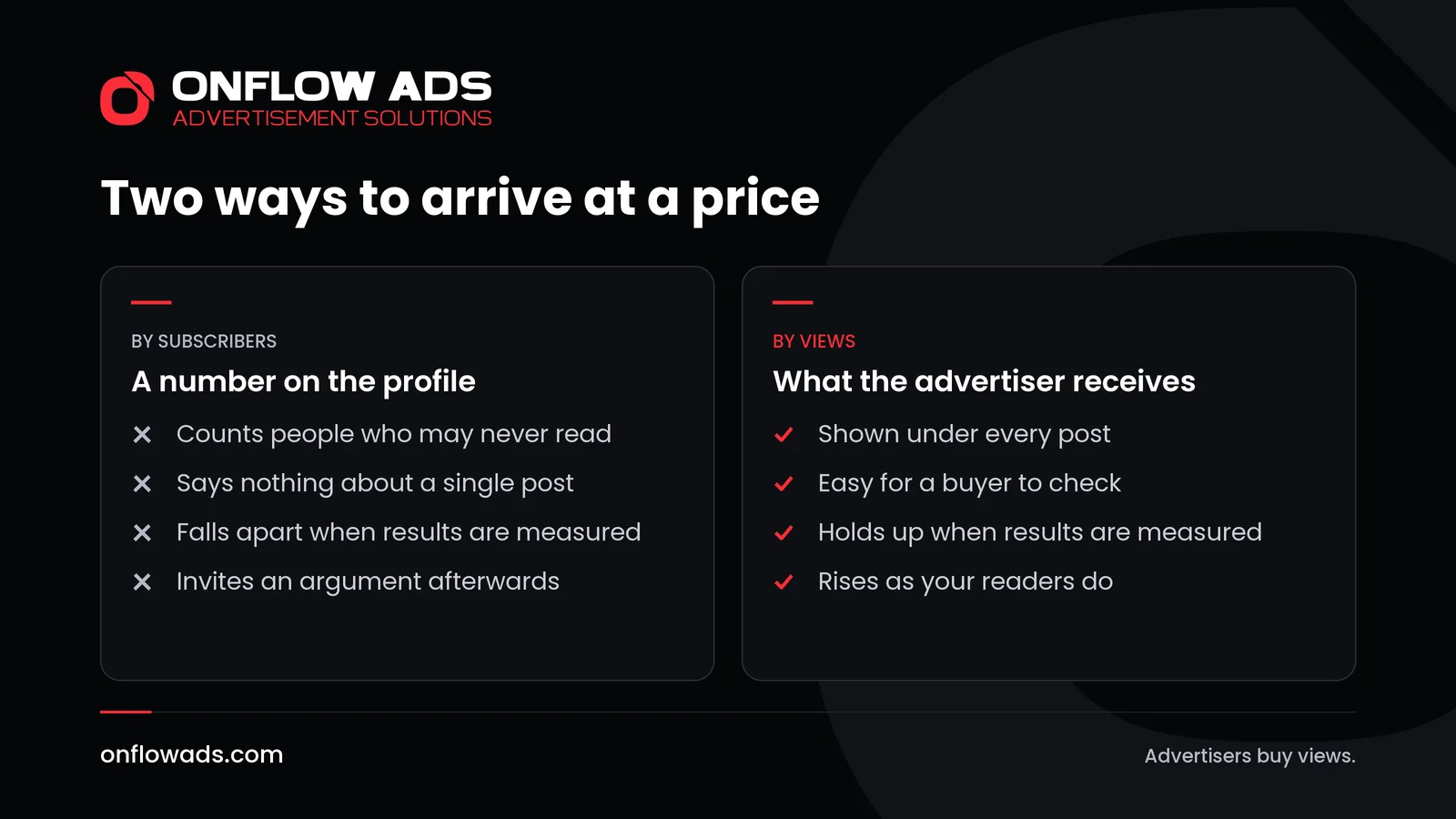
An advertiser is not buying your channel, your subscribers or your time. They are buying attention: the number of people who will see their post, for as long as it stays in view. Telegram shows that number under every post, in the view counter.
This is why two channels with the same subscriber count can fairly charge very different prices. If one gets 6,000 views on a post and the other gets 900, the first is selling nearly seven times as much. Telegram's own ad platform works the same way. It prices ads by the cost of a thousand views, a measure often shortened to CPM.
The sum: how to work out what to charge for Telegram ads
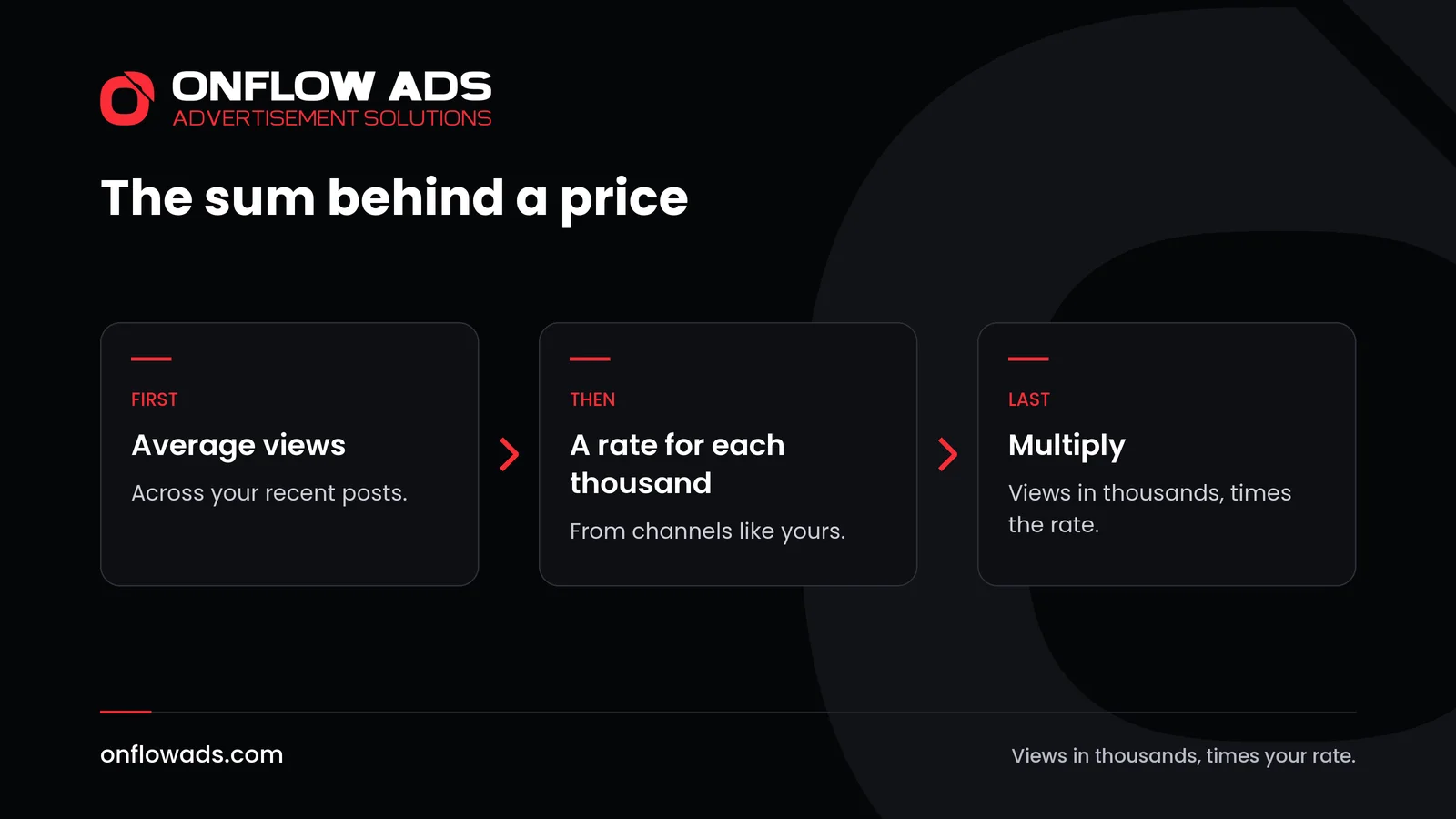
Find your average views
Take your last ten or fifteen posts, leave out the newest two or three, which are still being read, and average the view counts. Leave out any single post that went far beyond the others.
Choose a rate for each thousand views
Look at what channels on your subject, of about your size, charge for a post, and divide each price by that channel's usual views in thousands. The middle of those figures is your starting rate.
Multiply
Your average views in thousands, times the rate. That is the price of your shortest format.
Price the longer formats above it
More hours as the newest post, and more days in the feed, are worth more. Step the price up for each.
Publish it
Put the prices on a rate card, so that every advertiser sees the same figures.
Review it every month
Views change, and so does demand. A price set once and never revisited is wrong within a season.
A worked example
Suppose your channel's recent posts average 6,000 views. You look at five channels on your subject. Dividing each one's price by its views in thousands gives rates of 3, 4, 4, 5 and 9. The middle figure is 4, and the 9 is an outlier you can ignore. Your starting price is 6 times 4, which is 24, in whatever currency you sell in.
| Average views per post | Views in thousands | Price of the shortest format |
|---|---|---|
| 1,500 | 1.5 | 6 |
| 3,000 | 3 | 12 |
| 6,000 | 6 | 24 |
| 12,000 | 12 | 48 |
| 30,000 | 30 | 120 |
The figures in this table are arithmetic, not market prices. The rate of 4 is an example. Your own rate comes from the channels you compared, and it will differ from one subject to another.
What moves your price up or down
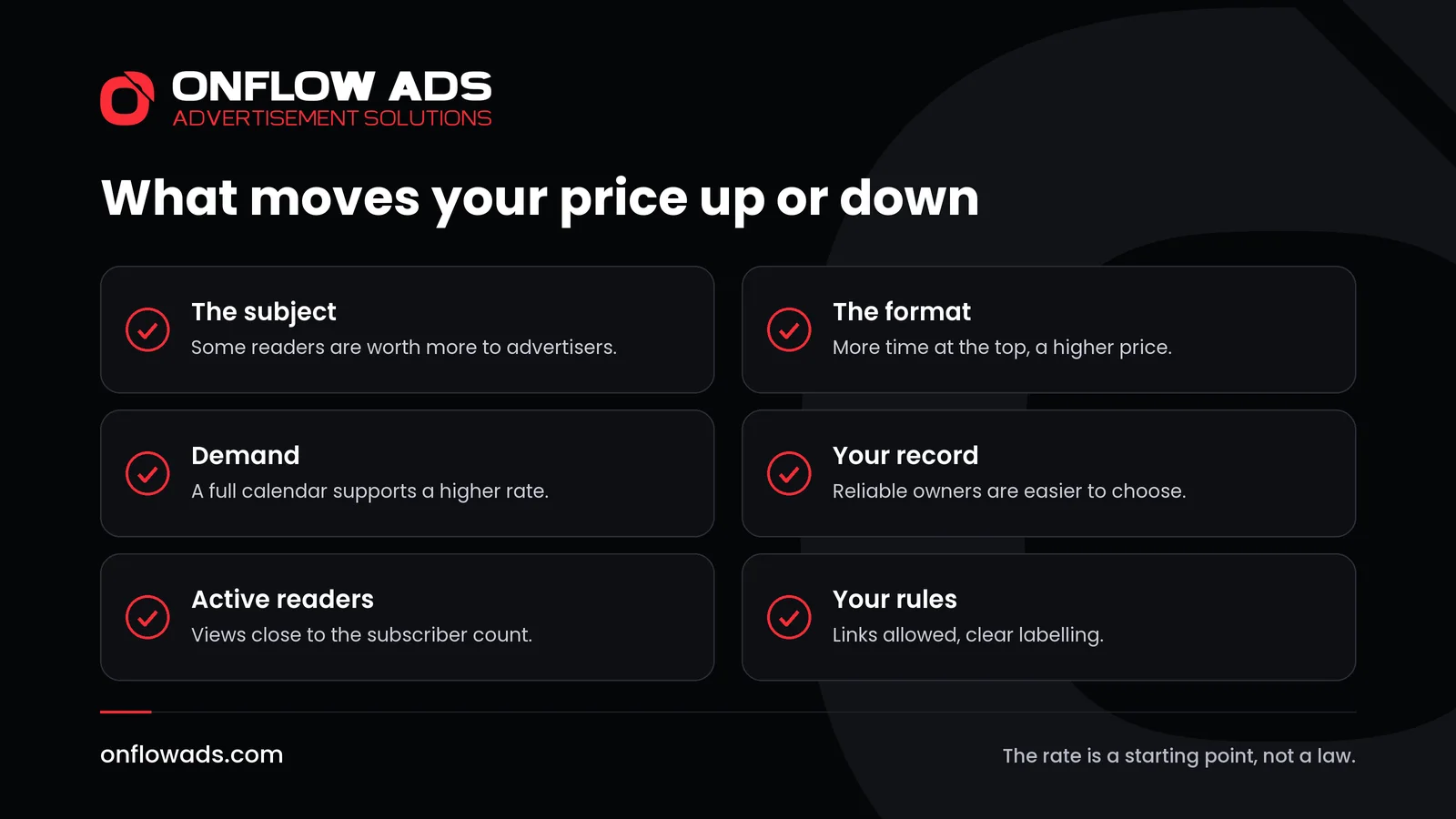
| Factor | Why it matters | What to do |
|---|---|---|
| The subject | Advertisers pay more to reach readers who buy | Compare only with channels on your subject |
| The format | Longer at the top and longer in the feed means more views | Price each format separately |
| Demand | A calendar that fills supports a higher price | Raise the rate when slots sell out |
| Your record | A buyer pays for certainty that the post will run | Deliver every booking as agreed |
| Active readers | Views close to the subscriber count show a live audience | Quote your views, not your subscribers |
| Your rules | Accepting links and labelling ads clearly widens the field | State the rules on the rate card |
On the subject: AdsGram, an advertising network, observes in its guide to buying ads that advertisers are often willing to pay more for a thousand views on Telegram than elsewhere, and that business, education, investment and technology have historically been strong subjects there. That is a reason to compare yourself with your own field and not with channels in general.
Build a rate card, not a single price
A rate card is a short list of what you sell and what each thing costs. It saves you from answering the same question twenty times, and it tells an advertiser that the price is the price.
- The shortest format first. One hour as the newest post and 24 hours in the feed is the entry format. AdsGram calls it the most budget-friendly option, and on Onflow Ads every listing has to offer it. Telegram ad formats explained covers the rest.
- Longer formats above it. Two hours and 48 hours, three hours and 72 hours, a week in the feed.
- A pin, if you offer one. Holding an ad at the top is a bigger promise than not posting for an hour. Price it as a separate thing.
- A discount for repeat orders. An advertiser who returns costs you no effort to find. A standing discount for them is cheaper than a new search.
Keep the card stable. Raising the price on the day someone is ready to pay is the fastest way to lose them, and in a marketplace it is visible. On Onflow Ads each listing shows the history of its entry price, precisely so that an owner cannot quietly raise the rate on the day a buyer commits.
How Onflow Ads helps you price
In the Onflow Ads marketplace the rate card is the product, and the owner sets every price on it. The platform gives you three aids.
- A look at your peers. An owner's account can browse the marketplace, so you can see what comparable channels charge before you price your own.
- A suggested price. When there are enough comparable channels in your category, the suggestion is the median of what they charge, scaled to your size. When there are not, it is estimated from your reach, and the page tells you to expect to adjust it. Every figure stays yours to change.
- Prices that follow demand. If you switch it on, your prices track how heavily your coming days are booked, within a band you choose. Switching it off restores the prices you set.
Two practical points. The price you set is not what reaches your wallet: the marketplace keeps 9% of a booking's price on the owner's side, 7% at the veteran rate, and every booking shows what you will receive before you accept it. The fees are on the pricing page. And there is no haggling on a booking. The advertiser books at the price on your card, or at a lower one you chose yourself with a discount or an auction, so the card has to be right.
Your record affects your income as much as your rate does. Clean deliveries, good reviews and quick answers lift your listing up the marketplace, where more advertisers see it, and your reliability score follows you into every deal. An owner who delivers every post as agreed can hold a price that a careless owner with the same views cannot. How to sell ads on your Telegram channel covers the rest of the selling side.
Pricing mistakes to avoid
- Pricing by subscribers. The advertiser will measure the result in views and taps, and the gap becomes your problem.
- Copying the price of a much larger channel.
- Quoting a different price to each person who asks.
- Selling so many slots that your readers leave. The audience is the asset.
- Never raising the price as the channel grows.
- Dropping the price the moment one advertiser says no.
A price is one decision among many. Telegram marketing: the complete guide covers the rest, from growing the channel to measuring what each ad brought.
Frequently asked questions
How much should I charge for an ad on my Telegram channel?
Multiply your average views per post, in thousands, by a rate for each thousand views taken from channels like yours. Use that for your shortest format and price longer formats above it.
Should I price by subscribers or by views?
By views. Views are what the advertiser receives, and they are shown under every post, so a buyer can check them.
What is CPM?
The cost of a thousand views. Divide the price of a post by its views in thousands. It lets you compare channels of different sizes.
Should a longer format cost more?
Yes. More time as the newest post and more days in the feed bring more views, and a pin is a bigger promise still.
When should I raise my price?
When your views have grown, or when your slots sell out as soon as they open. Review the card every month.
Does a marketplace take part of the price?
Yes. On Onflow Ads the owner receives the price less 9%, or 7% at the veteran rate, and each booking shows what you will receive before you accept it.

Comments
Nobody has commented yet.