A good Telegram ad post is short, specific and written for the people who read that particular channel. It opens with what the reader gains, says what the thing is, gives one reason to believe it, asks for one action and offers one link. That is all. An ad that tries to say everything ends up saying nothing a reader can act on.
This guide gives you the structure, shows weak and strong versions of the same lines, covers the link, the picture and the rules, and ends with a checklist to run before the post goes to the channel's owner.
What a Telegram ad post is made of
A sponsored post in a channel is an ordinary post. AdsGram, an advertising network, gives the format in its guide to buying ads: text with formatting, a photo or video, and a link in the text or on a button. Telegram's channels page lists the formatting you can use: bold, italic and underlined text, and links placed behind words.
It arrives the way every post in a channel does, with a notification, in a feed that the reader chose to follow. That is its strength. AdsGram puts it this way: when the post is done natively and is useful, the subscriber takes it as a recommendation from an author they trust. Your job is to deserve that.
The five parts of a Telegram ad post
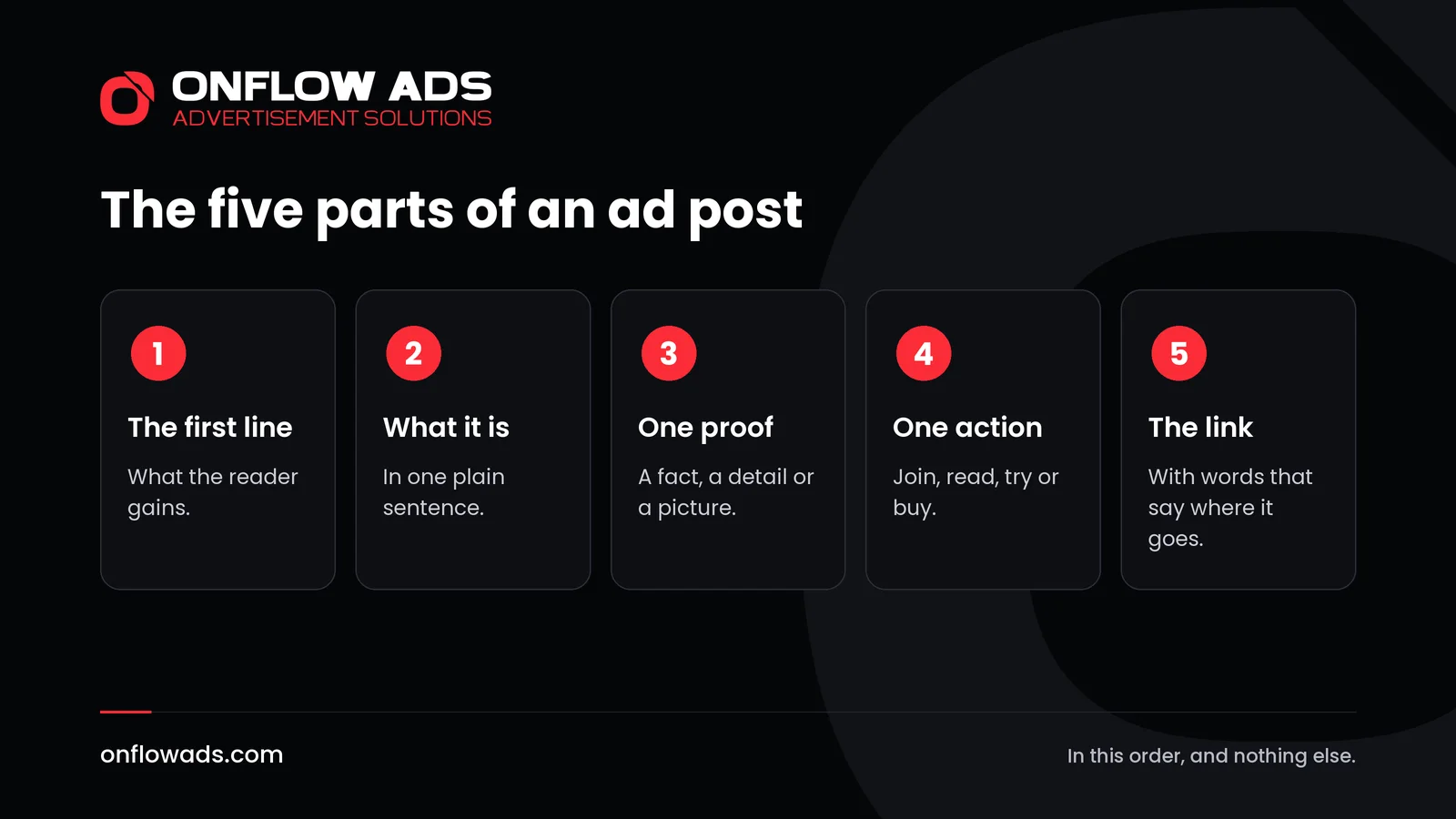
The first line: what the reader gains
Not your name, and not a greeting. The benefit or the news, stated for this channel's readers. It is the line that decides whether the rest is read.
What it is, in one sentence
A channel about home repair. A course for first-time managers. An app that splits a bill. If you cannot say it in a sentence, the reader will not work it out.
One proof
A fact you can stand behind, a detail that shows you know the subject, or a picture of the thing itself. One is enough.
One action
Join, read, try, order. Choose one and say it in plain words.
One link, with its own words
Put the link behind words that say where it leads, such as read the first lesson. Do not paste a bare address, and do not add a second link somewhere else.
Weak lines and stronger ones
The examples below are invented for an imaginary channel about home cooking. The pattern matters more than the words.
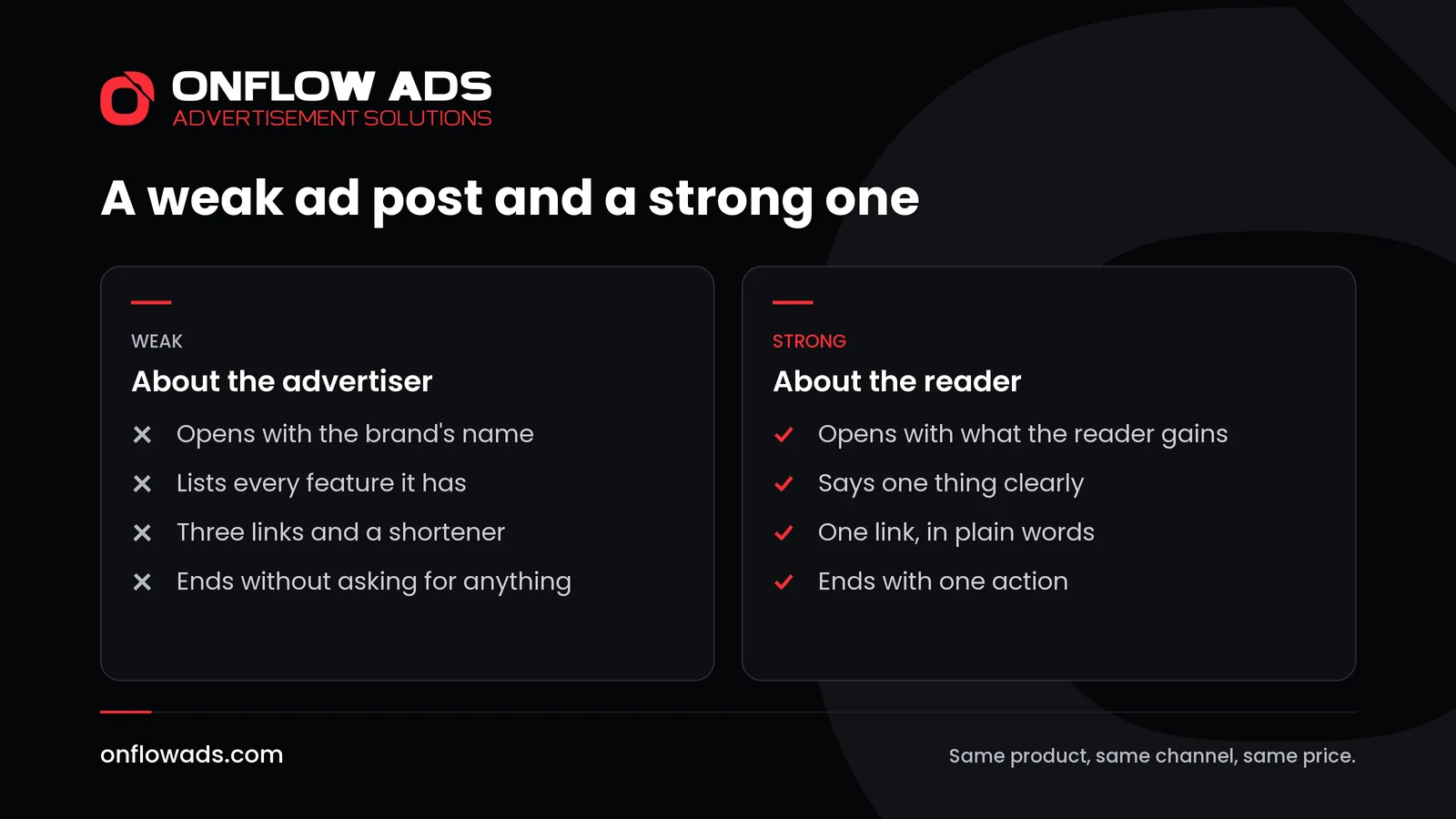
| Part | Weak | Stronger |
|---|---|---|
| First line | Welcome to our channel! | Dinner in 20 minutes, from what is already in your fridge. |
| What it is | We post lots of great content every day. | One recipe each evening, with a shopping list for the week. |
| Proof | Thousands of happy subscribers! | Tonight: a one-pan pasta, with photos of every step. |
| Action | Check us out sometime. | Join and cook tonight's recipe. |
| Link | A bare address pasted at the end | The words open the channel, linked |
Notice what the stronger column leaves out. There is no best, no number one, no row of exclamation marks. It simply tells a person who likes cooking what they will get and when.
Write for the channel, not for yourself
- Read the channel's last ten posts before you write. Note how long they are, how formal, and whether they use pictures.
- Write in the channel's language. Telegram asks the same of its own advertisers: its ad policies say the language of the channel should match the language of the ad and of the page it leads to.
- Borrow the channel's tone, not its voice. Do not pretend the owner wrote it, unless the owner did.
- Offer something that makes sense to those readers. The same product may need a different first line in every channel you buy.
If you are swapping shoutouts with another channel instead of paying, the same applies. On Onflow Ads each side of a cross-promotion writes the post about its own channel and reviews the other's before either goes out.
The link: get this part right
- One link. Every extra link divides the reader's attention.
- The right page. Send people to the thing the ad described, not to a home page they have to search. Telegram's policies make this a rule for its own ads: the destination must match the ad text.
- No shortener. A short link hides where it goes. Telegram's ad policies do not accept them, and neither does Onflow Ads.
- Words, not an address. A link behind words reads better and tells the reader what happens next.
On Onflow Ads there is a practical reason for that last point. Every link in an ad is published as its own tracked short link so that taps can be counted. A link you placed behind words keeps those words. An address pasted straight into the text is replaced by the words click here. Write the words yourself and you decide what the reader sees.
Pictures, formatting and buttons
- Use a picture if it shows the thing: the dish, the screen, the cover. A stock photo adds nothing.
- Use bold for one phrase at most. If everything is bold, nothing is.
- Keep emoji to one or two, or none. Telegram's own ad policies forbid intrusive, excessive or gimmicky use of them.
- A button under the post is a clear place for the action. Telegram lets bots add buttons to posts, and on Onflow Ads the number of buttons depends on your plan: one on Lite, up to four on Master and Ultimate.
Stay inside the rules
An ad that is refused reaches nobody. Three habits keep you clear.
- Do not claim what you cannot show. Telegram's policies forbid exaggerated comparisons and absolute claims in its own ads, and a careful channel owner will refuse them too.
- Do not dress the text up. Odd capitals, spacing and symbols are a reason for refusal on Telegram's platform, and they make any post look like spam.
- Check what the channel and the platform will not carry. Telegram ad formats explained covers what you are buying, and the channel's own rules cover what it accepts.
On Onflow Ads every post is checked before it can run, and a refusal names the rule it broke and, where the check can, quotes the words that broke it. The booking screen can also run a check of your ad against that channel's rules while you are writing it.
Getting help from the writing assistant
The post composer on Onflow Ads is the same for paid promotions, cross-promotions and exchange ads, and it has an AI writing assistant inside it. You give it a short brief and it drafts a post, and on Master and Ultimate it can make a picture for the ad as well. Two things about it are worth knowing. It is told to invent no facts, prices or numbers. And every result is a draft: nothing it writes is published until you have edited it and submitted it yourself.
Use it for a first version or a second opinion. The facts, and the decision, stay with you.
Test two versions
- Write two posts that differ in one thing only, usually the first line.
- Run them in two channels of the same kind, or in the same channel on different days.
- Give each its own link, so the taps can be told apart. On Onflow Ads this happens without any work: the same destination written twice gets two short links, each counted separately. By hand, Telegram invite links do the job.
- Keep the version that brought more taps for each thousand views, and test it against a new one.
AdsGram's advice to advertisers ends on the same note: prepare strong creatives and test several options. How to choose Telegram channels for advertising covers the other half, which is where the post runs.
Buying and running ads is one part of a bigger job. Telegram marketing: the complete guide puts every step in order, from setting up a channel to measuring what each ad brought.
Frequently asked questions
How long should a Telegram ad post be?
As short as it can be while still saying what the thing is and why it matters. For a post in a channel there is no fixed limit. Telegram's own sponsored messages are capped at 160 characters.
What should the first line of an ad say?
What the reader gains, in words that fit that channel. It is the line that decides whether the rest is read.
Should I use emoji in an ad?
One or two at most. Telegram's ad policies forbid intrusive or excessive emoji in its own ads, and a row of them makes any post look like spam.
How many links should an ad have?
One, behind words that say where it leads, and never a shortener.
Can AI write my Telegram ad?
It can draft one. The assistant in the Onflow Ads composer is told to invent no facts or prices, and every result is a draft that you edit and submit yourself.
Who should write the ad, me or the channel owner?
You know the product and the owner knows the readers. Write it yourself in the channel's tone, and take the owner's edits seriously.
Comments
Nobody has commented yet.