The question of Telegram Ads vs sponsored posts confuses people because both put an advertisement in a channel. They are bought from different sellers, look different, are priced differently and protect you differently. Telegram Ads are sold by Telegram: a short sponsored message that appears under the posts of many channels. A sponsored post is sold by a channel: one full post in that channel's own feed.
This article sets them side by side, then gives five questions that settle which one fits what you are promoting. You may well end up using both, for different jobs.
What Telegram Ads are
Telegram describes its ad platform as a tool to create sponsored messages in public channels with 1000 or more subscribers. The facts that matter to a buyer are these.
- The format. Each ad is an ad text and a button that opens a link. The ad policies cap the text at 160 characters including spaces, with no line breaks or lists.
- The destination. The platform's guide says links must lead to a channel or a bot on Telegram, and that links to external sites are not allowed.
- The targeting. You name the channels where the ad should appear by entering their links. Telegram says it does not use the contents of private chats or contact lists for targeting, and that its ads are not based on user data.
- The price. You set a price for a thousand views and a budget. The ad is shown until the budget is spent.
- The review. Telegram's team checks the ad's content before it can be displayed.
- Who does not see it. By default, subscribers to Telegram Premium.
Half of the revenue goes to the owners of the channels where the ads are displayed. The owner does not choose the ads and does not publish them.
What sponsored posts are
A sponsored post is the older form of advertising on Telegram. AdsGram, an advertising network, describes it in its guide to buying ads: you pay the administrator, and they publish the post. The format is text with formatting, a photo or video, and a link in the text or on a button.
- It is a real post in the channel's feed, and it arrives with the same notification as any other post.
- Its length and its link are whatever the owner accepts.
- It is sold in formats such as 1/24: an hour as the newest post, then a day in the feed. Telegram ad formats explained covers them.
- Its price is set by the channel's owner, for the post and not for the views.
- It can be bought in a chat with the owner, through Telegram's suggested posts, or through a marketplace.
AdsGram adds the reason it works: when the post is done well, the subscriber takes it as a recommendation from an author they trust.
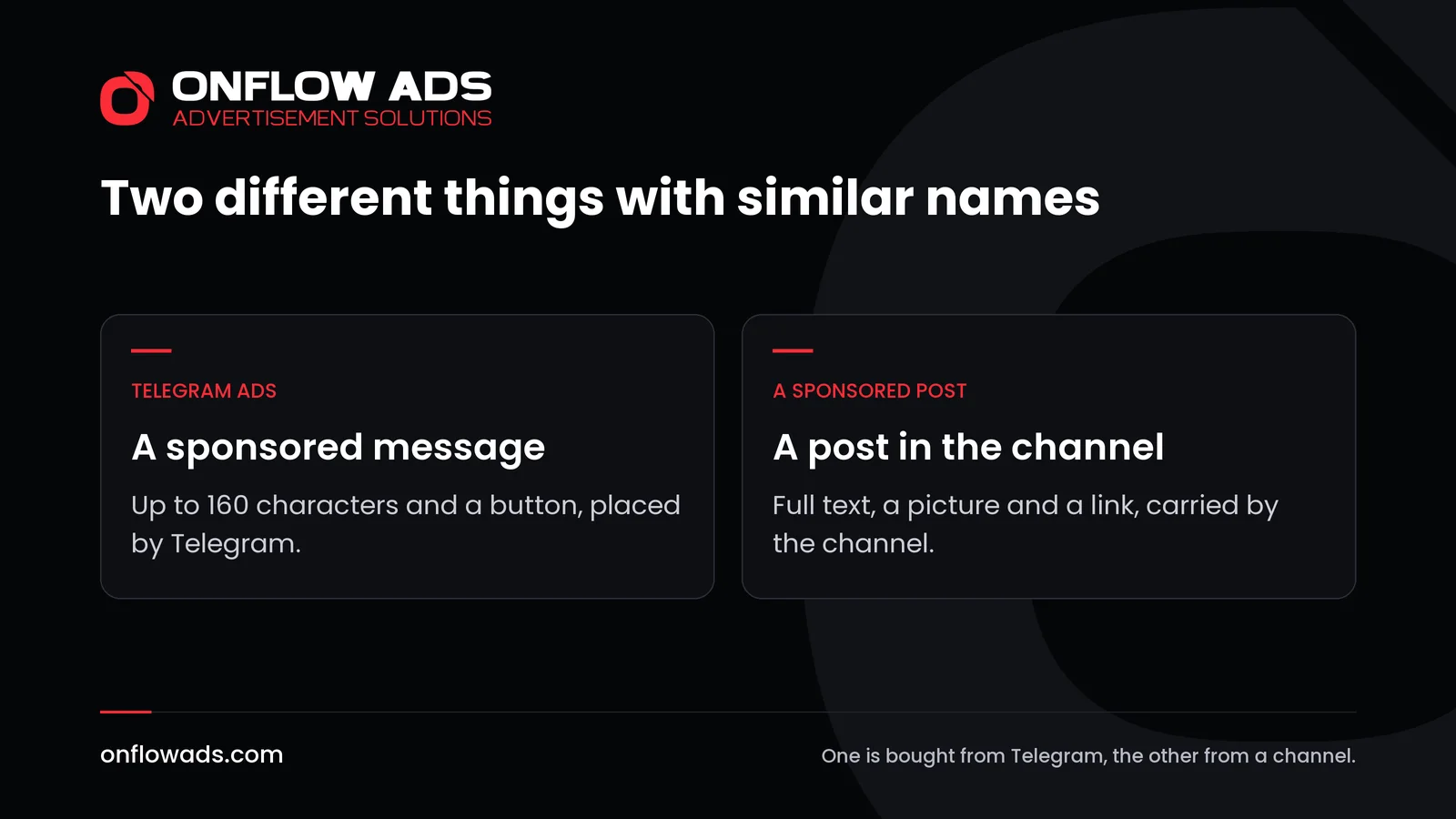
Telegram Ads vs sponsored posts, side by side
| Telegram Ads | A sponsored post | |
|---|---|---|
| What it is | A sponsored message under a channel's posts | A post in the channel's feed |
| Length | Up to 160 characters and a button | A full post with a picture |
| Where the link can go | A channel or a bot on Telegram | Wherever the owner accepts |
| Who sells it | Telegram | The channel's owner |
| How it is priced | A price you set for a thousand views, and a budget | A fixed price for the post |
| Which channels | Public channels with 1000 or more subscribers that you name | Any channel that sells posts |
| Seen by Premium subscribers | Not by default | Yes, it is an ordinary post |
| What you can measure | Views, and joins or bot starts after viewing | Views of the post, and taps if the link is tracked |
| What protects you | Telegram runs the ad | It depends on how you buy |
The last line is the one to think about. With Telegram Ads the seller is Telegram, so the ad runs or your budget is not spent. With a sponsored post the seller is a stranger, and what protects you is the way you pay.
The strengths and weaknesses of each
AdsGram's guide lists both fairly. For Telegram Ads it names scale, automation and the ability to appear where admins do not sell posts, against a format it calls short and dry, plus moderation and payment requirements. For posts bought from owners it names the strongest integration and room to present a product in detail, against a lot of manual work, the risk of inflated numbers and difficulty scaling without a system.
In plain terms: Telegram Ads are easy to run and hard to say much in. Sponsored posts say a great deal and take more care to buy well.
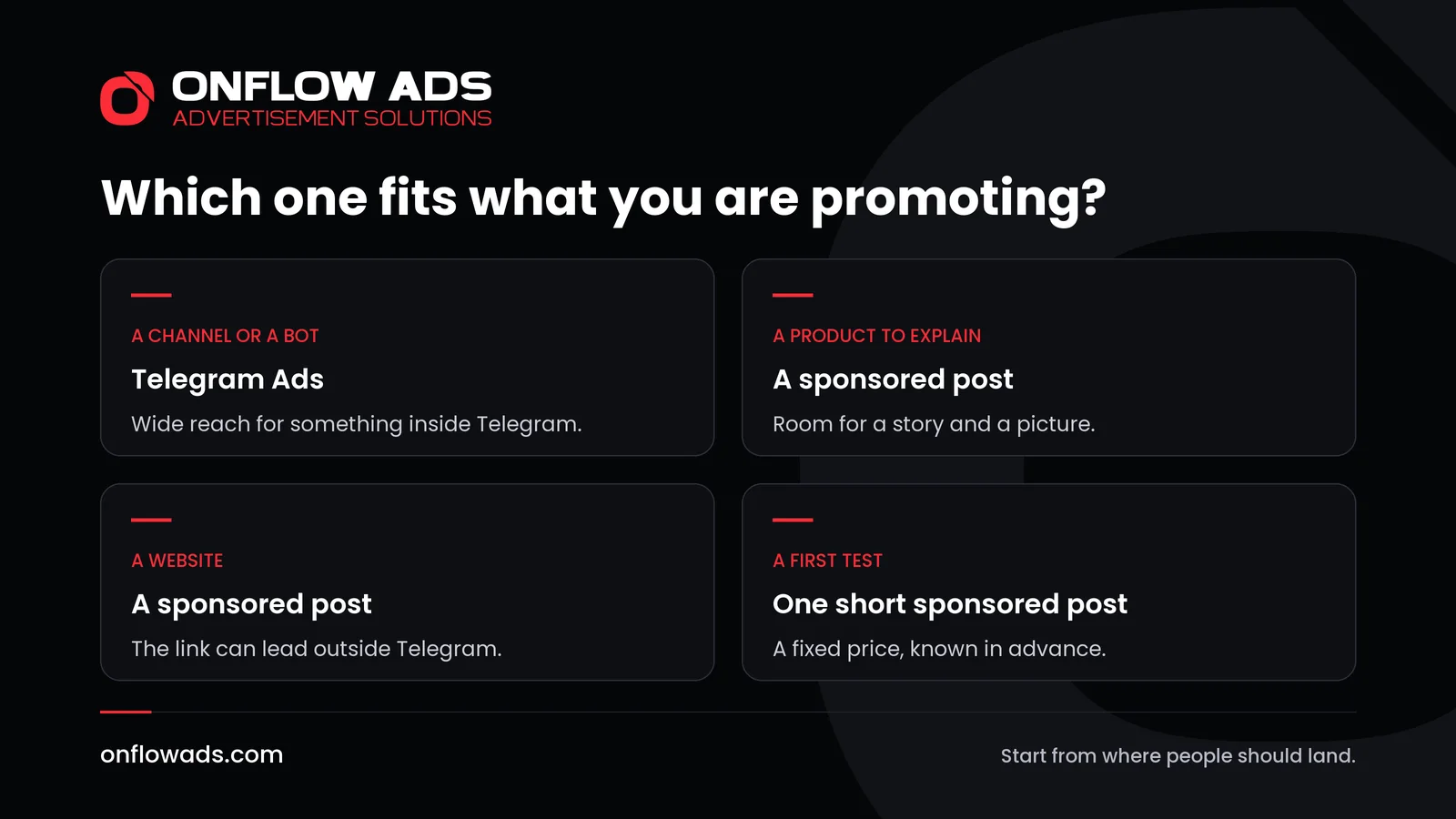
Five questions that decide it
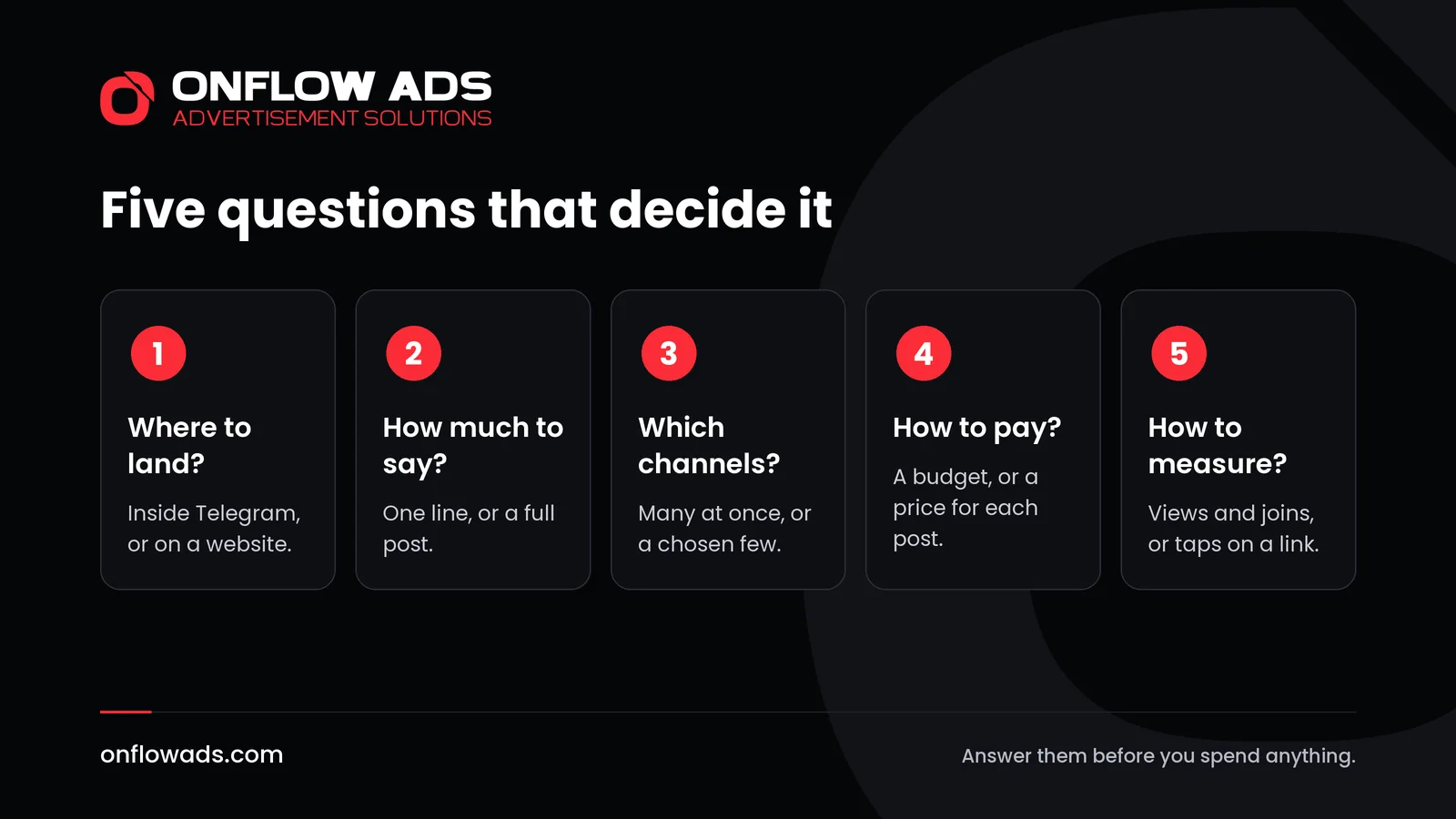
Where should people land?
If the answer is a website, Telegram's own ads are out: their links must stay inside Telegram. A sponsored post can carry the link.
How much do you need to say?
A channel that explains itself in a line suits 160 characters. A product that needs a reason, a picture and a price needs a post.
Do you want many channels or a chosen few?
Telegram Ads spread one message across every channel you name. A sponsored post is one channel at a time, chosen by hand.
How do you want to pay?
Telegram's ads are paid from a budget in a cryptocurrency, by the thousand views. A sponsored post has a fixed price that you know before you commit.
How will you measure it?
Telegram shows views and how many people joined or started the bot after seeing the ad. For a sponsored post, give the link its own count. Telegram invite links shows how.
If you buy a sponsored post, buy it safely
The weakness of a sponsored post is not the format. It is the deal. Paying a stranger first, with a screenshot as the only proof, is how money is lost. There are three ways to avoid that.
- Telegram's suggested posts hold the payment and pay the owner 24 hours after the post goes up.
- A marketplace holds the payment for the whole run. What is escrow on Telegram explains how that works.
- A record of the owner's past conduct tells you whom to choose in the first place.
The Onflow Ads marketplace does all three for sponsored posts. It lists every verified channel that is taking bookings. The payment waits in escrow, and a post that never goes up is refunded automatically. The bot publishes the post itself and keeps checking that it is still up. Every link in the ad is counted. And every account carries one reliability score from 0 to 10, which rises when deals are kept and falls when they are broken, so deleting an ad early has a cost that follows the owner into every later deal.
Using both together
- Start with one or two short sponsored posts in channels on your subject, to learn which message works.
- Keep the channels that brought results and book a longer format there.
- If what you promote is a channel or a bot, add Telegram Ads with the line that worked, to reach channels whose owners do not sell posts.
- If you own a channel yourself, add the free route: a cross-promotion with a channel on your subject costs nothing.
Buying and running ads is one part of a bigger job. Telegram marketing: the complete guide puts every step in order, from setting up a channel to measuring what each ad brought.
Frequently asked questions
Are Telegram Ads and sponsored posts the same thing?
No. Telegram Ads are short sponsored messages that Telegram places in channels. A sponsored post is a full post that a channel's owner agrees to carry.
Can Telegram Ads link to a website?
Telegram's guide to its ad platform says links must lead to a channel or a bot on Telegram, and that links to external sites are not allowed.
Do Telegram Premium subscribers see ads?
By default, no: Telegram says subscribing to Premium hides ads in channels. A sponsored post is an ordinary post, so every subscriber of the channel can see it.
Which is cheaper?
It depends on the channel and on your price. Compare the cost of a thousand views: for Telegram Ads you set it yourself, and for a sponsored post you divide the price by the channel's usual views.
Does the channel owner choose which Telegram Ads appear?
No. The advertiser names the channels, and Telegram places the ads. The owner receives a share of the revenue.
Can I use both?
Yes. They do different jobs: sponsored posts explain, and Telegram Ads repeat a short message widely.
Comments
Nobody has commented yet.