
The short answer to Telegram channel vs group is that a channel is a broadcast and a group is a conversation. In a channel only the admins post and everyone else reads. In a group every member can write. Which one you need depends on what you want people to do there: read you, or talk to each other.
This article sets the two side by side, shows when each one fits, and explains how to join a group to a channel so that you get the reach of one and the conversation of the other.
What is a Telegram channel?
Telegram's channels page describes a channel as a tool for broadcasting public messages to large audiences. A few things follow from that.
- Only admins have the right to post.
- A channel can have an unlimited number of subscribers.
- Messages show the name and photo of the channel, not of the person who wrote them. The owner can switch on admin signatures if readers should know who posted.
- Each post sends a notification to subscribers' phones. An admin can also send a silent message, which arrives with no sound.
- The subscriber list is visible only to the owner and the admins.
- A new subscriber can read the whole history of the channel.
A public channel has a username, can be found in Telegram search and can be read in a browser, where search engines index it. If you do not have one yet, how to create a Telegram channel takes you through it.
What is a Telegram group?
A group is a shared chat. Telegram's groups page calls groups a tool for building communities and says each one can hold up to 200,000 members. In a group:
- Every member can write, unless an admin has restricted them.
- A reply or a mention notifies the person it is aimed at, even if they have muted the group.
- A pinned message notifies all members, even those who muted ordinary messages.
- Admins can be given specific sets of rights, and a member who causes trouble can be put into read-only mode instead of being banned.
- A log of recent admin actions, kept for 48 hours, shows the admins who did what.
- Bots can be added for jobs such as automated moderation.
A group can be public too. It then gets a short link, and anybody can view its whole chat history and join to post.

Telegram channel vs group: the differences side by side
| Channel | Group | |
|---|---|---|
| Who can post | Only admins | Every member |
| How many people | No limit on subscribers | Up to 200,000 members |
| The name on a message | The channel's | The member's own |
| A notification is sent | With each post | For replies and mentions, even when muted |
| When it is public | Found in search, readable in a browser | Anybody can read the history and join to post |
| Telegram's sponsored messages | Shown in large public channels | Not shown |
| What it is for | Publishing to readers | Talking with members |
One line of that table deserves a note. Telegram says its ads are shown only in large public channels and never in your chats, which is why they do not appear in groups.
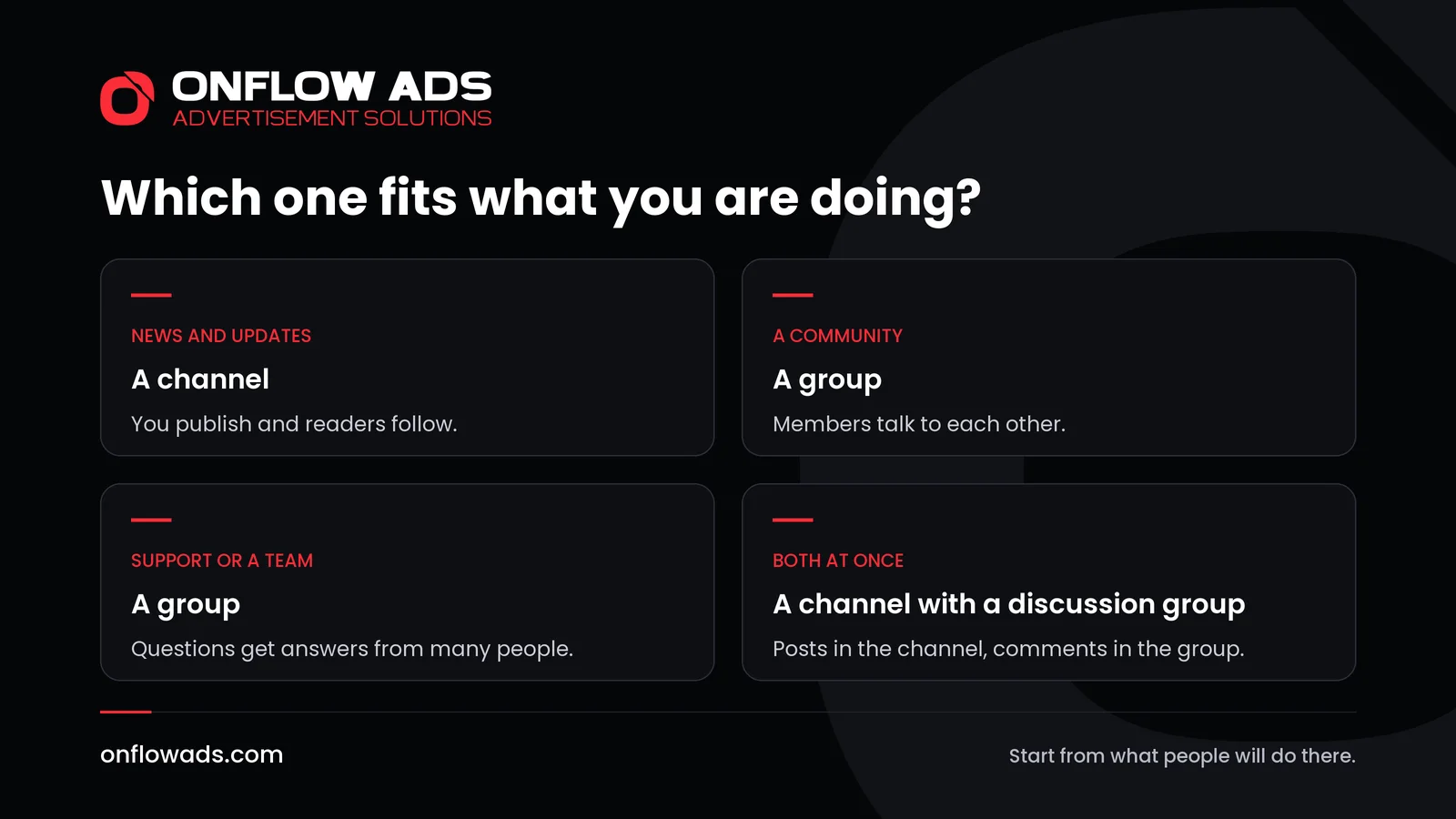
When to choose a channel
- You publish and people follow: news, articles, offers, lessons, a daily pick.
- You want each post to stand on its own, with a link that can be shared.
- You expect far more readers than writers.
- You want numbers. Telegram gives channels above a size it sets detailed statistics on growth and on how posts perform.
- You plan to earn from the audience or to advertise the channel. Both run through channels.
When to choose a group
- The value is in members talking to each other: a community, a class, a club.
- People need answers from many others, not only from you: support, a team, a neighbourhood.
- You are happy for anyone to start a topic.
- You have people to moderate it. A group with nobody watching fills up with noise.
Telegram itself draws the line by size and purpose. Its groups page says that if you are doing something massively popular, you should consider creating a channel.
How much work each one takes
A channel is quiet to run. Nobody but the admins can post, so there is nothing to moderate until you switch on comments. The work is in writing posts worth reading.
A group needs watching. Telegram gives admins the tools for it: specific rights for each admin, partial bans that stop a member from sending stickers or media for a period, and admin bots that can apply bans automatically. A pinned message can be edited at any time, so it can hold the rules and an up to date list of links to important messages. None of that runs itself. Somebody has to read the chat.
In a public group you can also copy a link to a single message, and anyone can open it without a Telegram account. That is useful for an answer you want to point people to again and again.
Use both: a channel with a discussion group
You do not have to choose. Since 2019 a channel's admins have been able to add a group to the channel to serve as its discussion board. Each new post in the channel is then forwarded to the group automatically and pinned there.
In 2020 Telegram built comments on top of this. Posts in a channel that has a discussion group carry a comment button. The comments appear in a thread under the post and also land in the group, which makes them easier for admins to keep civil. A reader who comments without joining the group is told about replies in a chat called Replies.
Create the group, or pick one you already run
It will hold every comment, so choose a group you are ready to moderate.
Open the channel's settings and choose Discussion
Telegram's own words for the path are Channel Settings, then Discussion.
Add the group
From now on each new post in the channel is forwarded to the group and pinned there.
Publish a post and check it
It should have a comment button. Write a first comment yourself to see where it lands.

In July 2026 Telegram went a step further with communities: several groups, channels and bots can be linked together around a shared topic, and members of the community can see its other chats and join them at once.
What the choice means for growth and advertising
If you want to grow an audience and earn from it, the tools are built around channels.
- Telegram's ad platform describes itself as a tool for sponsored messages in public channels with 1000 or more subscribers.
- Promo swaps happen between channels. Two channels recommend each other, as our guide to Telegram cross-promotion explains.
- Onflow Ads accepts public channels. Private channels, groups and personal accounts cannot be added, so a group cannot take part in swaps, in the ad exchange or in the marketplace.
A group still earns its place beside the channel. It is where readers answer back, and what they say there tells you what to publish next.
Three set-ups that work
- A publisher. One public channel. Comments come later, once there are enough readers to make a thread worth opening.
- A community. One group, with a pinned message that holds the rules and the links people keep asking for.
- A business. A public channel for announcements, a discussion group for questions, and admins who each have only the rights their job needs.
Mistakes people make with the choice
- Running a group as a news feed. Announcements get buried under replies.
- Running a channel when the point was a conversation. Readers have nowhere to answer.
- Switching on comments with nobody to read them.
- Opening a second place too early. One channel that is alive beats a channel and a group that are both quiet.
Growing a channel is one stage of the whole job. Our complete guide to Telegram marketing covers every stage, from the first post to the numbers that show what worked.
Frequently asked questions
What is the main difference between a Telegram channel and a group?
Who can post. In a channel only admins post and subscribers read. In a group every member can write.
Can a Telegram channel have comments?
Yes. Add a discussion group to the channel and each post gets a comment button. The comments show in a thread under the post and in the group.
How many people can join a group or a channel?
Telegram allows up to 200,000 members in a group and sets no limit on the subscribers of a channel.
Can people find a channel or a group in Telegram?
A public channel has a username and can be found in Telegram search. A public group has a short link, and anybody can read its history and join to post. Private ones are joined by invitation.
Which is better for a business?
Usually a channel for announcements, with a group beside it once there are enough readers to keep a conversation going and somebody to moderate it.
Do Telegram ads appear in groups?
Telegram says its ads are shown only in large public channels. Its ad platform places sponsored messages in public channels with 1000 or more subscribers.



Comments
Nobody has commented yet.